



 Back to Resources
Free IT service management tools will provide startups and small IT units with a realistic way to implement structure, accountability, and simple ITIL-compatible practices without making a huge platform investment in 2026. These tools will enable you to centralise the tickets, keep track of the assets, and automate basic workflows, instead of using email and spreadsheets, allowing the service desk to expand as the business grows. The trade-off here is that there is always a limit to the number of people who can use it, what it does or how it supports you, and you must be aware of these limitations at an early stage.
Meanwhile, the wider ITSM community is growing, with organisations such as the Service Desk Institute (SDI) focusing on excellence, continual improvement, and training on the latest ITIL-conformant models as the basis for tool selection. In the case of a small team, it does not initially depend on which software is free. But what free software will let you operate like a modern, improvement-driven service desk on day one?
Best Free ITSM Solutions for Small Teams
In the case of small IT departments, the most practical free ITSM solutions can be divided into two categories: open-source tools that you can host on your own, and cloud SaaS tools that provide significant free plans. Open-source solutions like GLPI and iTop provide traditional ITSM features, including asset management and configuration databases, at no licensing cost; however, you are left to host, upgrade, and maintain them yourself. The tools are appropriate for technical teams that feel comfortable managing infrastructure or desire extensive control over IT service modelling.
SaaS products such as Zoho Desk, Freshdesk, and Jira Service Management offer free plans that are production-ready for a very small team, with you just needing to implement a fast, easy-to-set-up, and familiar cloud interface. Although these free plans typically limit the number of agents or highly automate their development, they work well with other business apps and make transitioning to paid versions much easier when you are no longer using the bare minimum. A shortlist that includes at least one open-source solution and one or two SaaS solutions is a reasonable compromise between control and convenience to most startups.
Snapshot of Key Free Tools
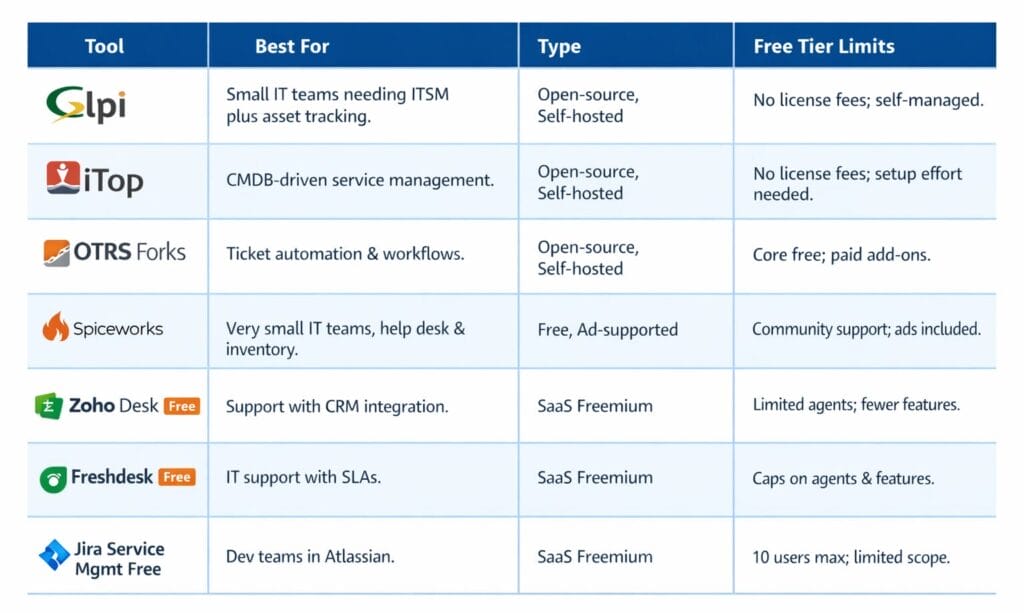
It is a broad range, encompassing full ITSM stacks based on a CMDB (GLPI, iTop), as well as broader service desks that can be readily adapted for multi-purpose support. A small company may lean towards Zoho Desk or Freshdesk for their faster speed, whereas a technical team with strong internal administration can favour GLPI and iTop for their asset and configuration capabilities.
Functionality, Restrictions, And Scalability: What To Expect
The first thing one should do when considering free ITSM software is to be brutally honest about what you really need over the next 12-24 months. Incident and request management is a mandatory requirement for most small IT teams; you simply need a common point where issues can be logged in, allocated, followed up, and communicated with the user in a clear manner. Other simple SLAs and prioritisation (e.g., the ability to set severity and due dates) are typically provided in addition to this basic ticketing feature and are available in numerous free tools. When your startup is powered by a large number of laptops, cloud tools, and several high-priority applications, native asset or configuration management will be highly valuable, and at this point, GLPI and iTop are especially effective.
Knowledge management and self-service must not be viewed as features that can be ignored, even at the free level. An easy portal or FAQ that allows the user to search for answers and log requests minimises the number of tickets and establishes a more professional service experience. Basic automation (ticket creation from email, automatic assignment rules, notification workflows, etc.) is also present in many of them, which saves time and provides consistency, but is occasionally limited in free versions or only available on paid plans. In the process of evaluation, you should be more selective in choosing a platform that your critical automations are comfortable with in the free tier, instead of one that leads to a dead end and requires you to work around it.
Free ITSM tools silently pull the line where limitations are involved. SaaS plans often have agent limits: free plans often only allow very small teams, and this plan works well initially, but may become a bottleneck as soon as you add second-line support or other features such as security or data. Other leverages include feature limitations, advanced reporting, asset discovery, change management, and problem management, as well as deep automation, which are frequently positioned behind a paywall. Open-source tools evade numerous licensing restrictions but replace those limitations with your own ability to handle hosting, monitoring, backups, and upgrades, which is an actual expense despite no invoice.
Scalability must be considered both process-wise and technically. GLPI and iTop can be scaled to larger environments, provided you invest early in modelling services and assets correctly and create a CMDB that will be useful as you add more devices, locations, and services. When your ticket volume is increasing rapidly, and routing is becoming complex, and you must be familiar with the roadmap and support model of the particular OTRS fork, they can work well. Cloud-based applications such as Zoho Desk, Freshdesk, and Jira Service Management are designed to be scalable, enabling you to expand to the next level, increase the number of agents, and support other ITIL processes as the organisation grows. It is an appropriate solution when a startup is unlikely to grow quickly and has no desire to change to the next level of capabilities without changing vendors.
Training, The Role Of Best Practice And Community
Community and training can be as significant as naked functionality to low-end IT departments. Open-source ITSM solutions are often characterised by active forums, community documentation, and a set of available plugins that facilitate easier problem troubleshooting, configuration ideas, and inexpensive platform extension. This community-based support model can be incredibly efficient when the technical founder or IT lead is comfortable (and willing) to experiment and give back, but it can be slower and less predictable than vendor-supported support lines.
SaaS providers invest significantly in internal help centres, onboarding experiences, and learning materials, providing step-by-step instructions, webinars, and examples that demonstrate how to support core processes such as ticket categorisation, SLA management, and simple automation. In the case of a lean IT department, it can take days to weeks to go from sign-up to live service desk. Nevertheless, product-specific instructions do not necessarily lead to greater ITSM maturity; you will run the risk of implementing features without knowing whether they align with established frameworks such as ITIL.
In this regard, independent communities and institutes come into play. SDI has over 30 years of experience establishing a network of service desk professionals around the globe, offering training, resources, and excellence-oriented events in ITSM, not necessarily tied to a single tool. With the development of ITIL and the emergence of related issues, such as AI-based service desks and enterprise service management becoming commonplace, the training and membership capabilities of SDI can familiarise itself with how to design processes, calculate value, and improve every day, whether using GLPI, Zoho Desk, or any other platform. For a startup, a free (or cheap) tool and entry into this type of professional community can be an effective way to punch above your weight in terms of service quality.
When Free Is Enough And When To Step Up
The initial stage of a business course can be quite easily covered with the free ITSM software. When informal support is what you are trying to shift to a structured service, and you have only a few people on your IT team, a carefully selected free tool can provide the visibility, control, and simple reporting you require. During this stage, clarifying services, capturing the simplest workflows, and establishing expectations with users are the biggest wins, rather than purchasing the most complicated platform on the market. Free or open-source tools can be especially useful when you are comfortable with their hosting model, have a clear picture of your needs over the next one to two years, and are willing to engage with the product and professional communities to support you.
The inflexion point comes when the limitations of the free begin to interfere with the provision of sound service or business considerations. This will be experienced when you are constantly operating around features that were not available, such as constructing hand-made spreadsheets to track assets, managing change approvals via email, or balancing multiple tools to handle various components of the ITIL lifecycle. Other departments’ pressure may also be a push: as soon as HR, Facilities, or Finance are interested in utilising your platform, you need superior multi-department workflows, permissions, and reporting than many free tiers provide. Full audit trails, formal change management, and stronger evidence of SLA compliance, whether mandated by regulation or otherwise, can prompt you to consider paid tiers or more sophisticated products.
The easiest path at that stage is usually to scale up within the same ecosystem, purchasing a paid plan at a fairly reasonable price that allows access to more agents, more automation and more processes, without having to completely migrate. In the case of open-source platforms, a similar shift could be to outsource to a managed services provider or commercial partner that hosts and maintains the environment while you work on process design and improvement. Whatever path you take, based on the accepted best practice, you can leverage what SDI has to offer in terms of resources, events, and training on how to work in modern and results-driven service desks, and you can make sure that the investment in tools will yield real benefits to your users and your business.