


 Back to Resources
Enterprise Service Management Software: Taking ITSM Practices Business-Wide
Enterprise Service Management (ESM) software extends proven service management practices to other enterprise functions, such as HR, Facilities, Finance, Legal, and internal service groups, bringing service management to the enterprise with a consistent approach to requests, workflows, knowledge, and employee experience management.
If an organisation is familiar with ITSM, then ESM is the logical progression: build on the principles that underpinned ITSM’s success to improve visibility and service performance in IT, and extend them to service delivery across the business, rather than forcing a single department to create its own operating model.
This is important at SDI because service excellence is not a stand-alone technology project. SDI’s own advisory philosophy is to see platforms in harmony with people, processes, customer experience, business goals, and governance, rather than as a prerequisite of that. That’s not really about “rolling out one more tool”, it’s about creating a scalable internal service model throughout the organisation.
What is Enterprise Service Management?
ESM extends service management concepts, processes, and technology to other aspects of the enterprise. In reality, it involves providing employees with a more unified approach to getting help, seeing progress, receiving self-service answers, and communicating with other internal teams, all through a single service experience rather than multiple inboxes, shared inboxes, spreadsheets, and local hacks and workarounds.
The ESM operating model is supported by the “software” component (platform layer). A robust ESM platform should integrate request management, workflow automation, service catalogues, knowledge management, reporting, integration, and governance controls to enable multiple teams to provide services in a structured, measurable way.
ESM vs ITSM: What’s The Difference?
ITSM is about the design, delivery, support and improvement of IT services. Those disciplines are then carried over to other non-IT functions, broadening the scope from “how IT manages services” to “how the organisation manages internal services more broadly”.
This does not imply an opposition between ITSM and ESM. The model often serves as the basis for ITSM, and the enterprise-wide extension is ESM. The practical difference is that ESM has to consider broader workflows, stakeholders, privacy requirements, approval workflows, and service cultures, including those that don’t consider themselves to be service providers today.
So, Why Are Organisations Transitioning From ITSM To ESM?
There are many organisations that have grown to a stage where IT is functional for requests, incidents, workflows, and reporting, but other functions are still being handled by email, manual routing, disconnected forms, or local spreadsheets. This disparity results in an inconsistent employee experience, reduced visibility, duplicated work, and weak governance of internal services.
The shared services approach of ESM is appealing: a single platform, a more unified definition of ownership, more standardised processes, and the ability to gain a clearer understanding of service demand and performance across the business. This is reinforced by SDI’s approach to tool selection, which warns against feature-led buying and focuses organisations on beginning with service objectives, maturity, experience, and long-term ownership.
Use Cases
HR Service Delivery
HR is one of the most popular ESM use cases, as it has frequent repetitive internal requests, sensitive cases, structured approvals, and knowledge-rich interactions. Onboarding and offboarding, Policy enquiries, Reference enquiries, Payroll enquiries, Contract changes, absence management, and Employee lifecycle case management are typical workflows.
A mature ESM approach enables HR to offer a more concise catalogue of services, automate routine requests, ensure the secure sharing of confidential information with role-based access and enhance employee experience with self-service and effective case tracking.
Facilities and Workplace Services
The function of the facilities team often means that they are involved in both reactive and planned service requests, in offices, sites and hybrid working environments, making them ideal candidates for service management practices. Examples of ESM use cases include: Access, Maintenance, Room move, Office setup, Health and safety, Cleaning, Parking, and Workplace support (assets).
When these services are integrated into an ESM platform, it can enhance routing, prioritisation, communication, and reporting capabilities, particularly when requests are across three or more functional areas of the business (Facilities, IT, Security, HR).
Finance and Shared Services
It is easy to imagine that finance teams are expected to support internal customers in a structured way through an approval-driven, policy-sensitive request, which is an ideal fit for ESM workflows. This can include purchase requests, supplier onboarding, expense exceptions, invoice queries, cost centre changes, and internal approvals that require a handoff that can be audited.
In such an environment, ESM software can be used to aid in the management of standard forms, rule-based routing, escalation logic, audit history and reporting of turnaround time or bottlenecks without compromising governance and compliance requirements.
Legal, Procurement, and Other Enterprise Functions
Legal, procurement, security, and corporate services are often classified as internal service providers outside day-to-day business, even if that is not the term used to describe them. For those teams, ESM enables them to better clarify services, manage intake, triage work, document commitments, and minimise reliance on unmanaged email-based workload management.
The important point to remember is not to make all departments an IT process. Instead, the platform should provide a common service management backbone, while offering department-specific workflows, controls, and terminology as needed.

Platform Features
The following are the features that every ESM platform should have as a minimum.
The primary query in evaluating enterprise service management software is not which vendor has the most features, but which platform is best suited to the organisation’s level of services, maturity, users and governance. The SDI advisory framework is particularly helpful here as it considers platforms through the lens of 6 dimensions: people and culture, processes and practices, technology and automation, customer and experience, performance and value, governance and operating model.
Some essential capabilities that should be listed on a shortlist of must-have ESM features are:
- Multi-department service catalogue and request management, allowing HR, Facilities, Finance and other departments to publish simple services in a single consistent user experience.
- Workflow automation and approvals, routing, escalation, SLAs or similar service targets, and team handoff.
- Knowledge Management and self-service: employees solve common problems without unnecessary tickets and are able to access answers in an organised manner.
- Clear role-based access and privacy management, particularly for HR, finance, legal and sensitive employee cases.
- Integration capability: Enable seamless connection between identity, collaboration, HR, finance, facilities, and IT systems, ensuring data is not siloed and handled redundantly.
- Beyond just activity, reporting, dashboards, value measurement, workflow performance, service outcomes, and adoption metrics demand insight.
- Configuration without harmful over-customisation, which SDI explicitly states can have negative consequences on adoption, sustainability, and value.
Features That Matter More At Scale
While some features are more satisfactory than others, they are not necessarily more important. As ESM grows, some functions gain greater significance than they initially appear to have. These include support for multiple operating units, delegated administration, service portfolio structure, reusable workflow components, governance controls, experience measurement, and the capability to standardise where appropriate, while preserving sensible local flexibility.
This is where many organisations stall: they purchase what is useful for the volume of tickets they expect to receive today, rather than the operating model of the enterprise they expect to run tomorrow. A platform that is successful for one IT team may not necessarily be successful for multiple functions, cross-functional work processes, or enterprise governance without extensive redesign.
Governance Questions
Questions to Answer Early: Governance and Ownership
A well-governed ESM journey is one of the key factors that distinguishes it from merely rolling out a single ESM tool in a couple of departments. Organisations should have a handful of questions about ownership they need to answer before choosing or expanding an ESM platform.
- Who is responsible for the ESM strategy – IT, shared services, transformation office or cross-functional steering group?
- What services should be prioritised on the platform first and then others later when processes are more mature?
- What needs to be consistent across the enterprise, and what can stay at the department level?
- Who approves workflow changes, catalogue design, automation rules and reporting definitions?
- What will be considered success: efficiency alone or employee experience, service quality, adoption, and business value?
- Who is responsible for the funding of the platform, integration, process ownership and continual optimisation?
Why these questions are important: ESM is more than a technology implementation. It shifts roles and boundaries across teams, reveals process issues and establishes new expectations for accountability and experience.
SDI Alignment
How SDI Standards and Optimisation Thinking Cross the IT Rubric
The Global Best Practice Standard for Service Desk of SDI is based on service alignment to business strategy, a definition of service maturity and guidance for service excellence. Although the approach is service-desk-based, the principles and practices carry over nicely to enterprise services, since they’re all the same: clear service definition, measurable performance, customer focus, governance, and continuous improvement.
Similarly, SDI’s optimisation and assurance efforts focus on the fact that technology should be used to provide great service, not to create it; and that organisations should not choose tools without first understanding the maturity of the process, the organisation’s capabilities, and its readiness for change. In ESM, non-IT functions can vary widely in terms of process standardisation and service ownership.
It’s helpful to consider SDI thinking in the context of enterprise services as follows:
- Look at the maturity of the service desk and how it compares with the enterprise service desk, noting the differences in service definition, service demand management, and service outcomes.
- Business Drivers / User journeys / Pain points before platform configuration – move from tool-first thinking to outcome-first design.
- Beyond ticket count to adoption, experience, turnaround, quality and business contribution: reporting, now for operational value realisation.
- Isolating improvement to enterprise governance: Ownership of standards, workflows, data and optimisation across functions.
Example ESM journeys
Many approaches are used to initiate ESM, and none suit every organisation. There are three typical trips:
Service-oriented expansion (IT-led): IT has a fairly well-developed service management capability, and service management is brought to HR, Facilities or Finance, usually beginning with a handful of high-volume workflows.
In the Shared Services redesign, the organisation employs ESM as part of a broader internal service transformation, with a unified service catalogue and governance model across a number of functions from the outset.
Organic department adoption: one department’s pain point in the IT world is met with value, and over time, it expands into a larger enterprise model without the IT department’s involvement.
An organisation could start by introducing onboarding for IT and HR, where the provision of devices, access, contracts, facilities access, and induction processes are managed in a cross-functional workflow, rather than as individual email chains. Another can begin in the Workplace Requests section of the Facilities module and then expand to include Finance approvals and procurement intake once governance, roles and reporting are established.
Evaluation Framework
A Vendor-Neutral ESM Software Evaluation Framework
An ESM evaluation framework should assess platforms based on the services they provide and how well they fit the organisation, rather than on the vendor’s bells and whistles. SDI’s six-dimensional approach is a good starting point for such an evaluation as it widens the scope of the discussion beyond technical.
The following categories may be used for a practical vendor-neutral framework:
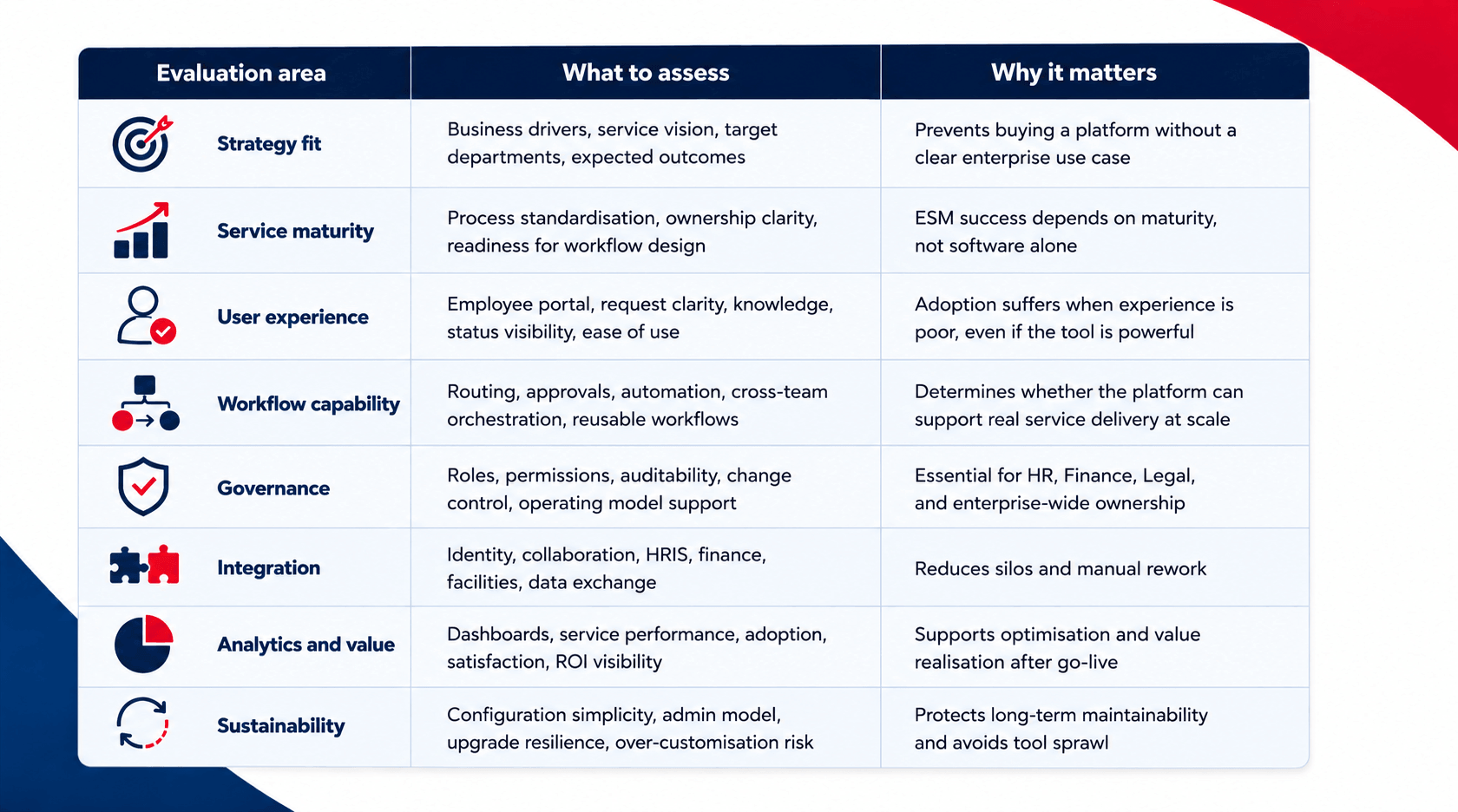
Each platform can then be scored 1-5 points on these criteria, and the scores can differ depending on the business priority, no longer based on the vendor’s demo capabilities. This often means that, for many organisations, the “best” product in the market is not appropriate for their governance model, maturity, or change capacity.