



For years, ITSM has provided the framework organisations need to deliver reliable services, manage incidents and control change. The principles of service management remain as important as ever, but the environments those principles are being applied to have changed significantly.
Cloud services, SaaS platforms, microservices, remote workforces and increasingly complex digital ecosystems have created operational challenges that many organisations are struggling to keep pace with. Service desks and operations teams are often overwhelmed by alerts, tickets, escalations and manual investigations, while business expectations around availability and user experience continue to grow.
As a result, many organisations are exploring how AI can help them move beyond reactive support models and towards more proactive and predictive operations. One company helping to drive that conversation is BigPanda, whose vision of Agentic Operations aims to combine operational intelligence, automation and AI-driven decision-making to help teams resolve, and increasingly prevent, incidents before they impact the business.
The Challenge with Modern Incident Management
Despite investments in monitoring, observability and ITSM platforms, many organisations still face familiar challenges:
- Repeated incidents consuming valuable support resources
- Slow root cause identification
- High volumes of operational noise and alerts
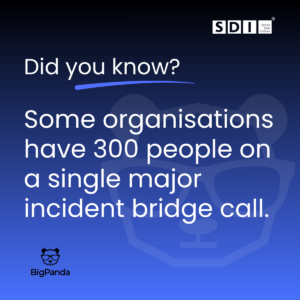
- Large major incident bridge calls involving multiple teams
- Time-consuming post-incident reviews
- Increasing pressure to reduce Mean Time to Resolution (MTTR)
- Change-related outages impacting critical business services
The challenge is rarely a lack of information. More often, it is having too much information spread across too many systems.
When incidents occur, service desk analysts, operations teams and technical specialists often need to gather data from monitoring tools, ticketing systems, collaboration platforms, knowledge repositories and change records before they can begin to understand what is happening. During major incidents, this process becomes even more difficult as multiple teams work simultaneously to diagnose and restore services.
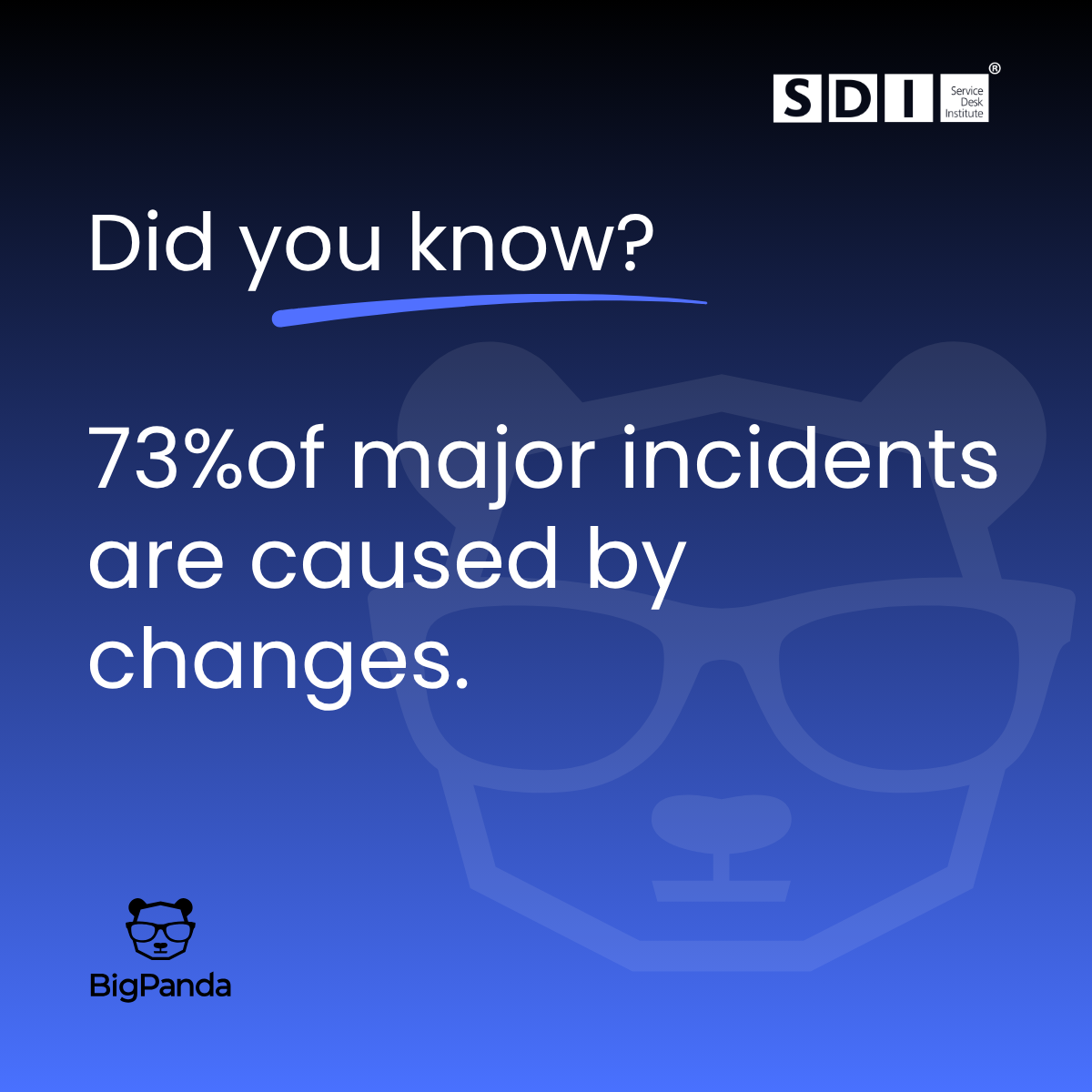
In a recent webinar hosted by SDI, BigPanda highlighted a statistic that resonates with many IT leaders: approximately 73% of major incidents can be traced back to change activity within the IT environment.
While change management processes exist to reduce risk, assessing the true impact of a change across a complex technology landscape remains a significant challenge.
From Reactive Operations to Agentic Operations
This is where agentic AI is beginning to gain attention.
Unlike traditional automation, which relies on predefined workflows and rules, agentic AI can analyse information, identify patterns, make recommendations and autonomously execute tasks within defined parameters.
In an IT operations context, this means AI can help teams understand incidents faster by bringing together information from across the technology landscape, including:
- Historical incidents
- Change records
- Service dependencies
- Knowledge articles
- Monitoring and observability data
- Major incident documentation
- Operational runbooks and procedures
Rather than requiring engineers to manually search multiple systems, AI can rapidly assemble operational context and present a consolidated view of the issue.
The result is faster decision-making, improved situational awareness and more effective incident response.
BigPanda’s Vision: From AIOps to Agentic Operations
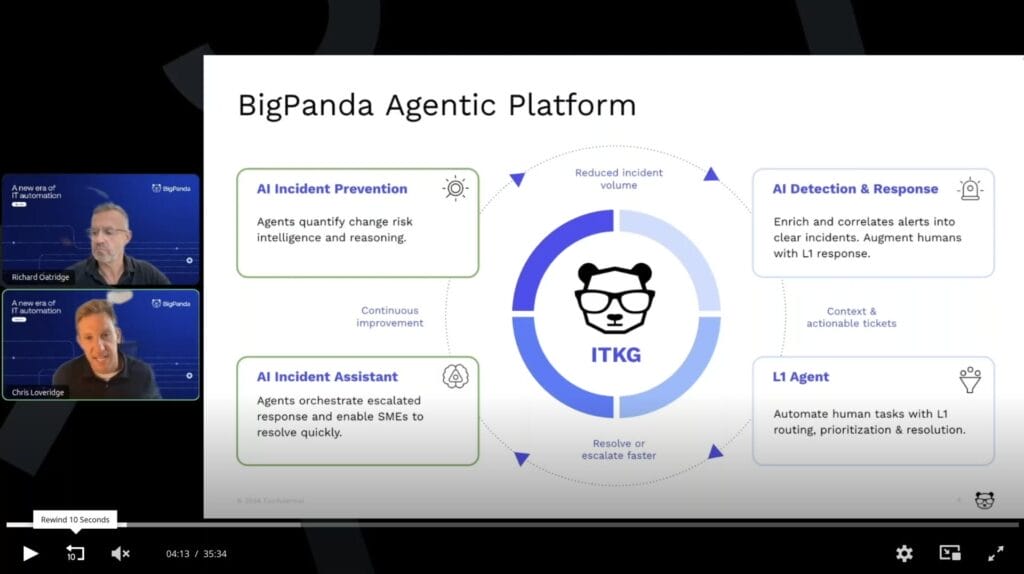
The concept of Agentic Operations sits at the centre of BigPanda‘s strategy.
Traditional AIOps platforms have focused heavily on reducing alert noise and helping operations teams prioritise incidents. BigPanda’s vision extends beyond this by using AI to support the entire incident lifecycle, from detection and investigation through to resolution and prevention.
The objective is not simply to automate individual tasks. It is to provide service and operations teams with access to the collective knowledge of the organisation.
By bringing together incident history, service relationships, operational documentation, change records and observability data, AI can provide responders with the context they need when they need it most.
This reflects a broader trend across the industry, where organisations are increasingly looking for ways to augment human expertise rather than replace it.
Accelerating Incident Investigation
One of the most practical applications of agentic AI is in incident investigation and response.
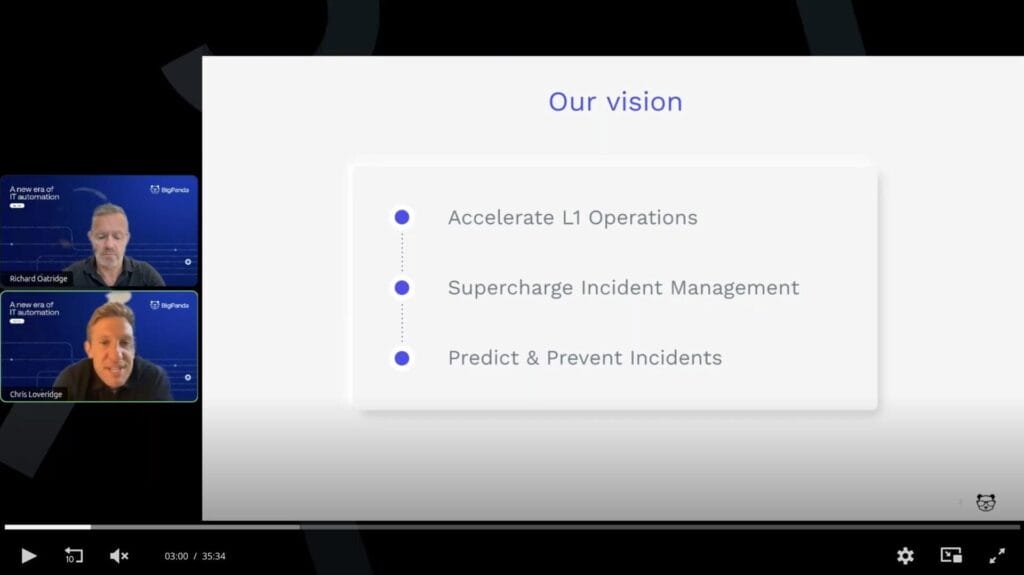
During a recent SDI webinar, BigPanda demonstrated how its AI Incident Assistant Biggy automatically gathered information from multiple operational systems and presented a consolidated view of an issue.
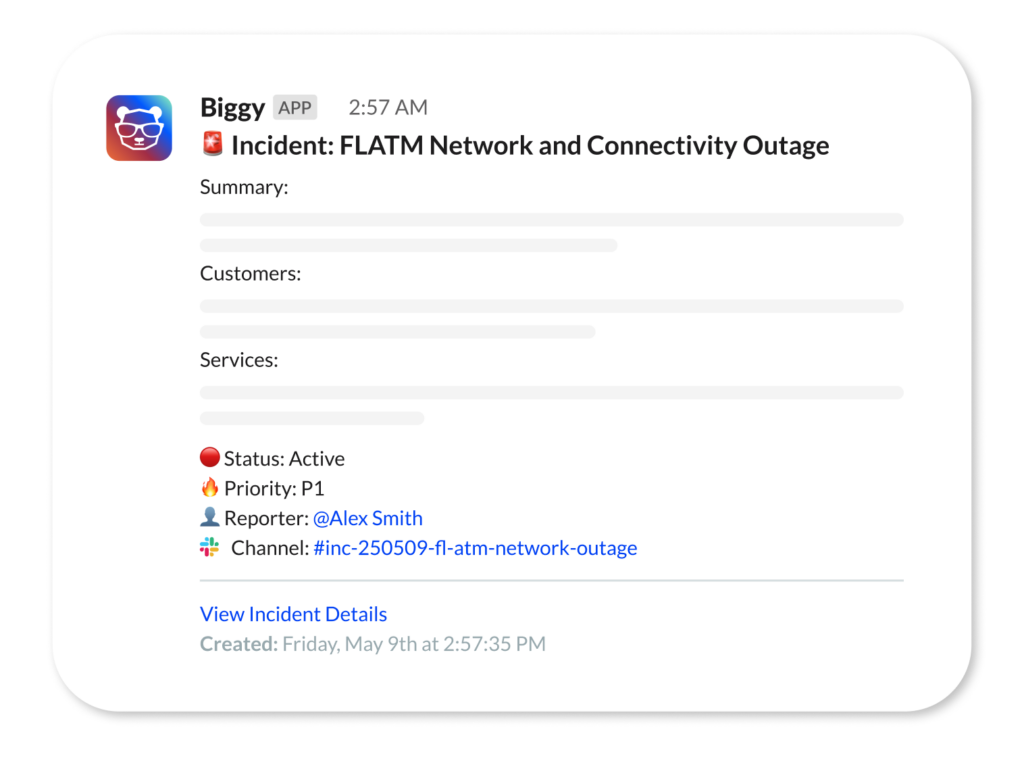
Rather than spending valuable time searching through tickets, documentation, monitoring tools and collaboration platforms, responders were presented with information such as:
- Potential root causes
- Related incidents
- Relevant service dependencies
- Suggested remediation actions
- Subject matter experts who may be able to assist
- Recent changes that could be contributing to the issue
For many organisations, these information-gathering activities consume a significant amount of time during incident response. By reducing manual investigation, teams can focus more of their effort on diagnosing and resolving the issue itself.
Improving Major Incident Management
Major incidents are often as much a coordination challenge as they are a technical one. Incident managers are typically responsible for bringing together the right teams, maintaining communication channels, updating stakeholders, documenting actions and ensuring progress towards service restoration. Many of these activities remain highly manual.
BigPanda demonstrated how AI can support major incident processes by helping organisations:
- Identify relevant responders
- Create and manage incident channels
- Generate stakeholder updates
- Maintain incident timelines
- Capture actions and decisions
- Support post-incident reporting
Reducing administrative effort allows incident managers to focus on service restoration and business impact, rather than coordinating logistics.
For organisations where major incidents involve numerous teams and stakeholders, this has the potential to improve both communication and operational efficiency.
Moving from Incident Resolution to Incident Prevention
While improving incident response remains important, many organisations are increasingly focused on prevention.
This is where BigPanda’s approach to change intelligence becomes particularly interesting.
Traditional change assessments often rely heavily on human judgement. Yet modern environments contain thousands of relationships and dependencies that can be difficult to understand manually.
By analysing historical incidents, service topology, previous change outcomes and operational data, AI can help organisations build a more objective assessment of change risk.
During the webinar, BigPanda demonstrated how proposed changes could be evaluated against factors such as:
- Implementation complexity
- Service impact
- Historical incident patterns
- Team performance history
- Organisational risk criteria
The goal is not to replace change management processes but to provide additional intelligence that helps organisations make better-informed decisions.
This reflects a broader shift taking place across IT operations. The conversation is increasingly moving beyond “How quickly can we respond?” towards “How can we prevent incidents from happening in the first place?”
What This Means for Service Leaders
As organisations continue to invest in digital services, the cost of outages continues to rise.
Service leaders are under pressure to:
- Improve service reliability
- Reduce operational costs
- Increase productivity
- Minimise customer impact
- Accelerate change safely
- Scale support capabilities without significantly increasing headcount
Agentic AI offers an opportunity to enhance existing ITSM processes rather than replace them.
By combining operational data, organisational knowledge and intelligent automation, organisations can accelerate investigations, improve incident response and reduce the likelihood of future disruptions.
Importantly, these capabilities are not a replacement for good service management. Strong governance, effective processes and skilled people remain critical. However, AI has the potential to help those people work more effectively by reducing manual effort and providing greater operational insight.
Looking Ahead
Whether organisations choose BigPanda or another approach, one thing is becoming increasingly clear: AI is moving beyond chatbots and self-service into the operational core of IT.
The most interesting developments are no longer focused solely on answering user queries or automating routine requests. They are focused on helping organisations understand their environments better, respond to incidents faster and make more informed operational decisions.
For service management leaders focused on reliability, resilience and operational efficiency, the rise of agentic AI is a trend worth watching closely.
As organisations continue to combine established ITSM best practices with AI-driven operational intelligence, the future of incident management may be defined not just by how quickly incidents are resolved, but by how effectively they are prevented altogether.