


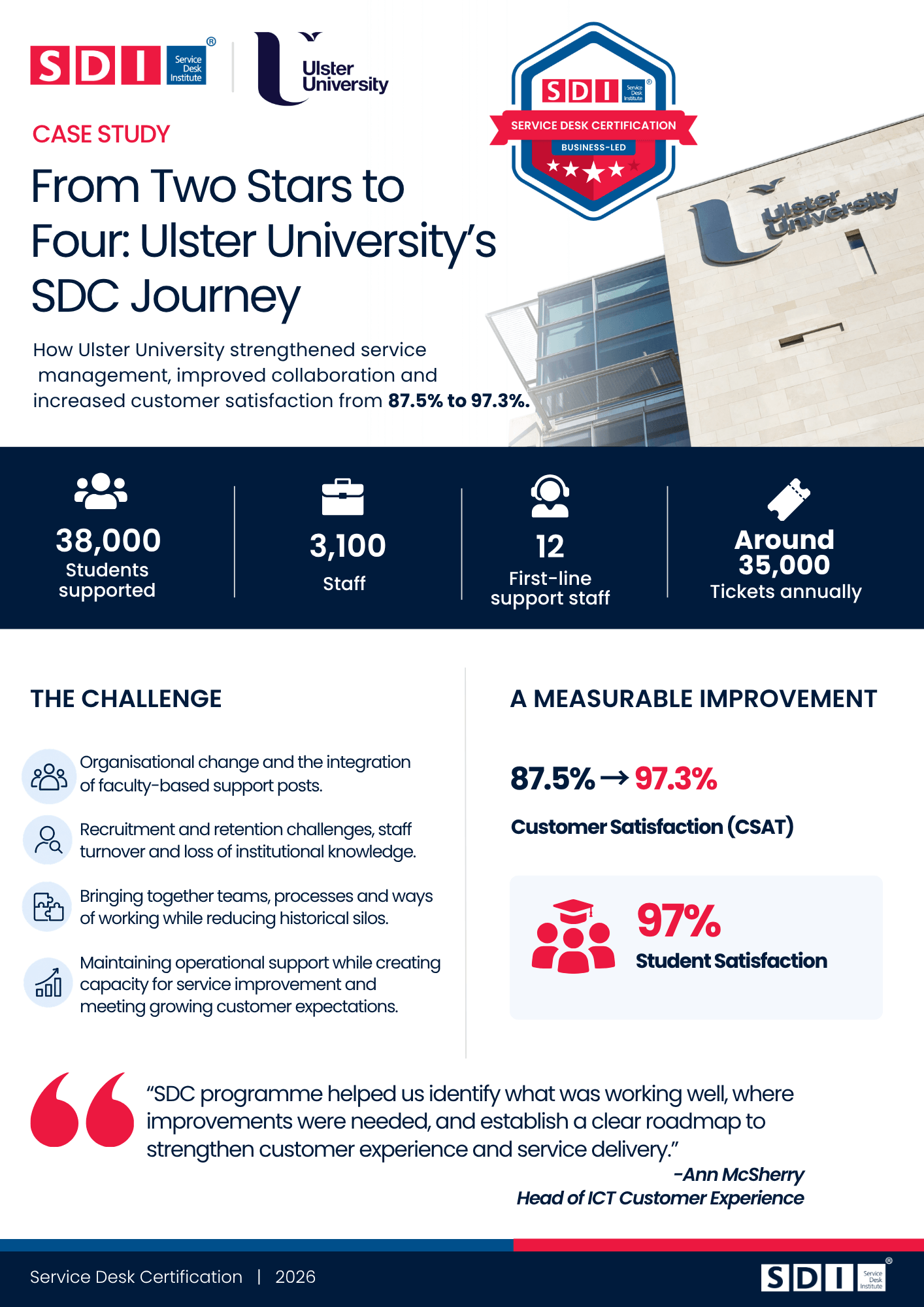
How Ulster University strengthened service management, improved collaboration and increased customer satisfaction from 87.5% to 97.3%.
Supporting approximately 3,100 staff and 38,000 students across a multi-campus university environment that brings significant demands for IT support. Ulster University’s ICT Customer Experience department has used Service Desk Certification as a framework to strengthen its service, bring teams together and create a more consistent customer experience.
We recently caught up with Ann McSherry, Head of ICT Customer Experience, and asked about their SDC journey.
Maintaining Service Quality Through Organisational Change
Q: Tell us about your service teams, customer base and ticket volumes.
Ann McSherry: Supporting a community of approximately 3,100 staff and 38,000 students across campuses in Northern Ireland, London, Birmingham, Manchester, and Qatar, the ICT Customer Experience dept within Digital Services operates a multi-tiered support structure. This includes 12 first-line support staff, seven of whom provide extended-hours coverage on a part-time basis; 25 second-line Technical Support staff across three Northern Ireland campuses; and 10 Customer Services staff with expertise in service analysis, audiovisual support, and educational technologies.
The team manages approximately 35,000 tickets annually, with monthly volumes ranging from 1,800 to 5,000 tickets, depending on academic activity throughout the year.
Q: What key challenges have you faced over the last few years?
Ann McSherry: Over the last few years, we have faced a number of significant challenges, including organisational change, the recruitment and retention of technical support staff in a highly competitive ICT market, and supporting the delivery of major Digital Services programmes designed to strengthen infrastructure, cyber resilience, and the overall digital experience for staff and students.
During this period, we also welcomed the integration of some faculty-based support posts into our technical support structure, creating a more consistent and centralised service model. This transformation was made more challenging by staff turnover and the resulting loss of institutional knowledge, alongside the need to support colleagues transitioning into new roles through targeted onboarding, training and development.
Bringing together teams, processes and ways of working required significant effort to improve consistency, share knowledge and reduce historical silos. At the same time, we needed to maintain high levels of operational support, meet growing customer expectations and create capacity for continual service improvement. Balancing these competing demands required a sustained focus on collaboration, workforce development, process standardisation and service maturity.
Using Certification as a Framework for Continual Improvement
Q: Why did you decide to pursue Service Desk Certification?
Ann McSherry: To showcase the excellent work already being delivered while creating a structured framework for continual improvement.
The Service Desk Certification (SDC) programme provided an opportunity to benchmark our service against recognised industry standards and take an honest assessment of our capabilities.
“SDC programme helped us identify what was working well, where improvements were needed, and establish a clear roadmap to strengthen customer experience and service delivery.”
– Ann McSherry, Head of ICT Customer Experience
The programme also aligned teams across Digital Services around common goals, processes and standards, while demonstrating the strategic value the Service Desk brings to the university community.
Q: What key changes have been made as a result of the certification journey?
Ann McSherry: The certification journey has driven significant improvements across Digital Services, including:
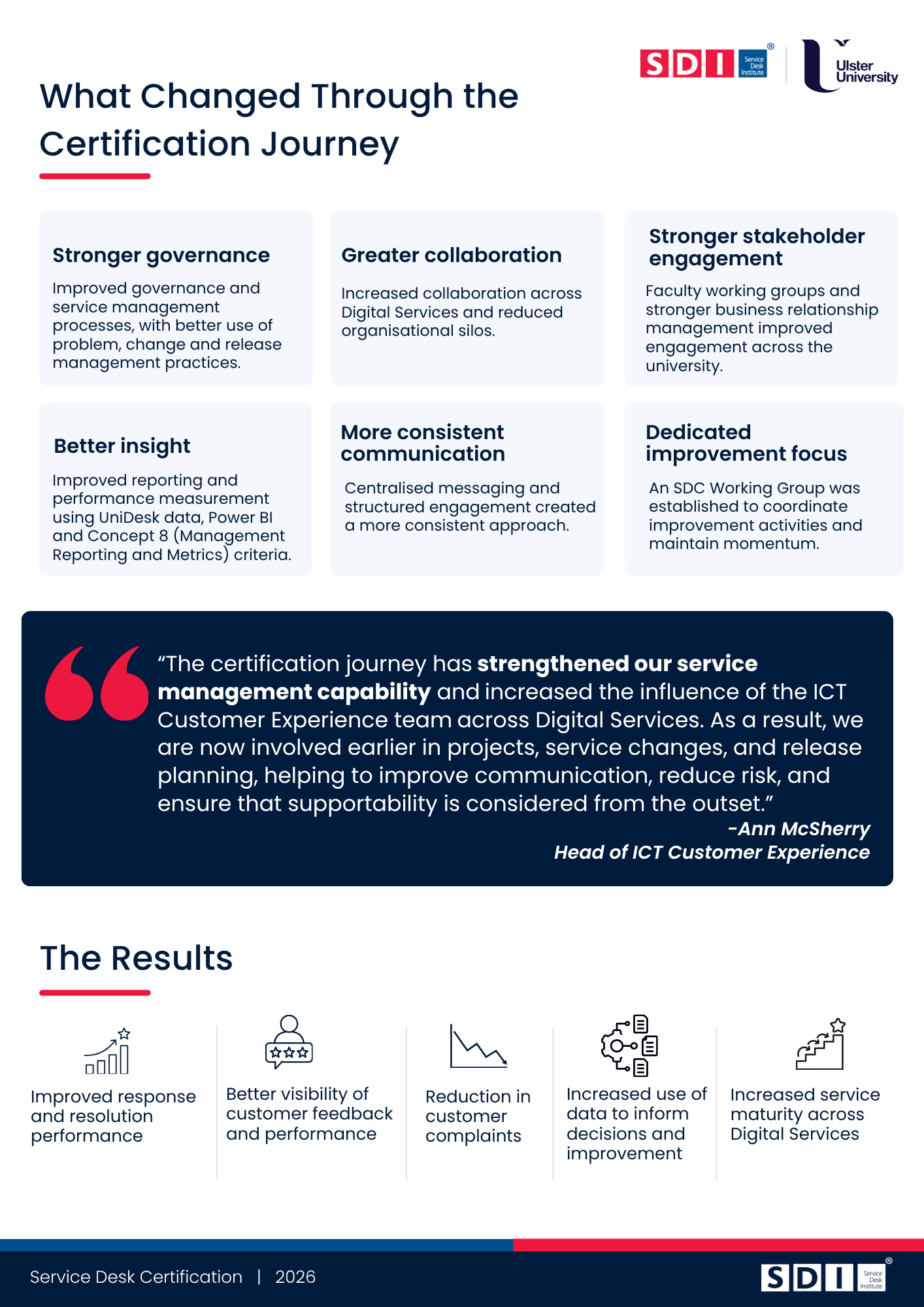
🔷 Establishment of a dedicated SDC Working Group to coordinate improvement activities and maintain momentum.
🔷 Greater focus on customer experience and customer journey mapping.
🔷 Improved governance and service management processes.
🔷 Increased collaboration across Digital Services and reduced organisational silos.
🔷 Enhanced stakeholder engagement through faculty working groups and stronger business relationship management.
🔷 Better use of problem, change and release management practices.
🔷 Development of more consistent communication through centralised messaging and structured engagement.
🔷 Improved reporting and performance measurement using UniDesk data, Power BI and Concept 8 (Management Reporting and Metrics) criteria.
The certification process has embedded a culture of continual review, accountability and service improvement.
➡️ Read more: Five Years of Continual Service Improvement – Ulster University
Q: What benefits have you seen from engaging with the SDI programme?
Ann McSherry: The programme has delivered benefits across multiple areas of the organisation.
We have strengthened relationships with faculties and stakeholders through dedicated working groups and regular performance reviews. Collaboration between teams has improved, and our ICT Customer Experience team is now recognised as a key stakeholder in projects, service changes and release planning.
We have also seen improvements in service reporting, communication, customer insight gathering and service management maturity. The SDI framework provided valuable structure during periods of significant organisational change, helping to establish more consistent processes and standards across Digital Services while embedding a stronger customer-focused culture throughout the organisation.
We Increased Customer Satisfaction from 87.5% to 97.3%
Q: Have your service metrics improved?
Ann McSherry: Yes. One of our most significant achievements has been improving customer satisfaction.
Our Customer Satisfaction (CSAT) score increased from 87.5% to 97.3%, while student satisfaction surveys also achieved 97% satisfaction. In addition, we have seen:
🔷 Improved response and resolution performance.
🔷 Better visibility of customer feedback and service performance.
🔷 More robust reporting via dashboards through Power BI and Concept 8 (Management Reporting and Metrics) criteria.
🔷Improved stakeholder engagement and customer insight gathering.
🔷 A reduction in customer complaints.
🔷 Increased use of data to inform decision-making and continual improvement.
🔗Download PDF – SDC Case Study – Ulster University
Q: How do you measure the value and return on investment of the certification journey?
Ann McSherry: We measure value through a combination of customer satisfaction, operational performance, stakeholder feedback and service improvement outcomes.
Regular reporting through UniDesk, Power BI and Concept 8 (Management Reporting and Metrics) criteria enables us to monitor key performance indicators including incident and request volumes, response and resolution times, customer satisfaction and service trends. We also gather qualitative feedback through faculty working groups, surveys, focus groups and various engagement activities.
“The certification journey has strengthened our service management capability and increased the influence of the ICT Customer Experience team across Digital Services. As a result, we are now involved earlier in projects, service changes, and release planning, helping to improve communication, reduce risk, and ensure that supportability is considered from the outset.”
– Ann McSherry, Head of ICT Customer Experience
The programme has also delivered value through improved consistency, stronger processes, enhanced knowledge sharing and increased service maturity. Investment in staff development and customer experience has helped us build a more capable and resilient team, while creating a culture of continual improvement that delivers long-term benefits for staff, students and the wider university.
Creating More Consistent Processes, Stronger Collaboration and Better Knowledge Sharing
Q: How has the certification programme helped overcome existing challenges?
Ann McSherry: The SDI framework provided a clear roadmap for managing change and improving service maturity across Digital Services.
It helped establish consistent processes, improve documentation, strengthen knowledge sharing, and embed ITIL-aligned service management practices across teams. These foundations were particularly valuable during periods of organisational change, including the integration of faculty-based support posts into a more centralised support model and the onboarding of colleagues into new roles.
The certification journey also helped break down historical silos by creating a common set of standards, goals and ways of working. This improved collaboration, strengthened performance measurement and stakeholder engagement, and provided greater visibility of service performance and improvement opportunities.
Most importantly, the programme created a culture of continual improvement, enabling us to maintain service quality, support staff development and respond more effectively to increasing customer expectations despite ongoing organisational and operational challenges.
➡️ Read more: ITSM Maturity Models: Your Roadmap to Service Excellence
Q: Would you recommend the SDI programme to other organisations?
Ann McSherry: Definitely.
While the programme requires a meaningful investment of time, effort and commitment, the benefits extend well beyond certification. It provides a recognised framework for driving continual improvement, strengthening customer experience, enhancing service management maturity, and benchmarking services against industry-leading standards.
Perhaps most importantly, it creates a culture of excellence and encourages teams to continually review and improve the services they provide.
From Two-Star to Four-Star SDI Accreditation
Q: What are you most proud of?
Ann McSherry: The commitment shown by the SDC Working Group in driving service improvements has been exceptional. Achieving a four-star SDI accreditation, progressing from a two-star rating, is a significant accomplishment and reflects the dedication, professionalism and collaborative effort of colleagues across the ICT Customer Experience department and wider Digital Service teams.
It has been equally rewarding to see the positive transformation in customer perception and satisfaction. Consistent feedback describing our staff as friendly, professional, efficient, helpful and effective demonstrates that our mission, values and commitment to customer service are being experienced by the people we support.
The improvements in communication, collaboration, service quality and customer satisfaction are achievements that every member of the team should be proud of. These successes have been delivered while continuing to provide high-quality services within a busy, multi-campus university environment, demonstrating the resilience, commitment and professionalism of our colleagues.
Q: What advice would you give organisations starting their SDI journey?
Ann McSherry: Start early, secure leadership support and build a dedicated working group to drive the programme forward from the outset.
“Break the journey into manageable bite-sized chunks and focus on continual improvement rather than trying to achieve everything at once. Learn from organisations that have already completed the process and use the framework as a roadmap to improvement rather than a compliance exercise.”
– Ann McSherry, Head of ICT Customer Experience
Most importantly, don’t become overwhelmed by the scale of the framework. Focus on making small, meaningful improvements, celebrating progress along the way and keeping the customer at the centre of everything you do.