



 Back to Resources
The following is a list of typical XLA errors and some suggestions on how to prevent them.
XLAs can be powerful, but only when implemented properly. There are a number of things that many organisations do wrong when implementing Experience Level Agreements, and these can leave them with issues that make them confusing, ineffective or unmanageable.
Fortunately, many of these issues can be prevented. By knowing where teams go wrong, you can have a much better starting XLA.
Mistake 1: treat an XLA as if it were an SLA
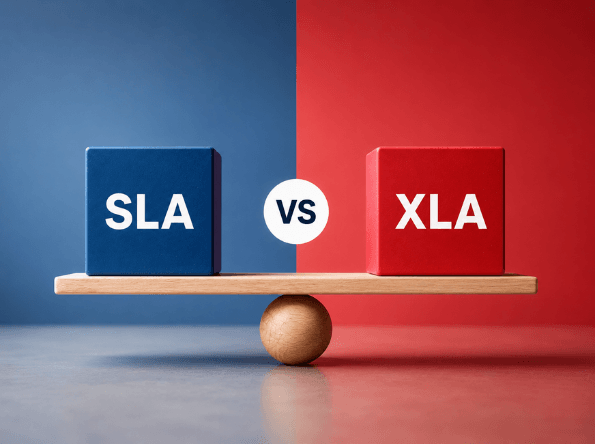
It is common to make the mistake of converting the XLA into an SLA with another name. This framework isn’t really measuring experience if it only measures response times, resolution times and escalations.
An XLA should be centred on the user’s experience of the support and what it brings to them. This implies that it’s a topic that calls for discussions of sentiment, clarity, confidence, and ease.
Mistake 2: measuring too much
Often, people make the mistake of measuring everything. This results in information overload and increased difficulty in managing the XLA.
A better idea would be to select a few meaningful measures for each trip. If the scorecard is too general, it causes the team to lose focus and the stakeholders to lose interest.
➡️ Read more: How To Measure XLAs In IT Support
Mistake 3: Forgetting the user journey
XLAs are best used in conjunction with authentic service journeys. A framework constructed solely on the basis of categories of tickets or technical procedures might not reflect the user’s experience.
The service desk should consider the whole lifecycle of the incident – logging it, updating it, handing it off, resolving it and acting on it. That provides a clearer idea of what’s causing friction or satisfaction.
Mistake 4: Taking in feedback, but not taking action on it
This can be one of the fastest routes to destroying trust. Users that are asked for feedback but nothing is changed will cease to participate.
All XLA’s should have improvement loops. That is, feedback is followed by analysis, analysis is followed by action, and action is communicated back to users or stakeholders, as appropriate.
Mistake 5: Only thinking about satisfaction
Satisfaction is key, but not the only key. A friendly interaction can still be inefficient or cause downtime, but a user will still say it was a good interaction.
That is why, along with effort and productivity measures, outcome measures should be included in XLAs. This is more useful and more balanced.
Mistake 6: Lacking ownership
When no one owns the XLA, it is not a management tool; it is a reporting tool. Ownership needs to be clearly understood at the journey, data, and improvement levels. If ownership is unclear, so are issues; accountability suffers, and the XLA loses credibility.
Mistake 7: Not communicating value
The reasons for the existence of XLAs can be misunderstood unless the stakeholders are informed about that. They could be perceived as soft measures or as not required in Administration.
To prevent that, make a clear business case. XLAs can enhance productivity, reduce friction and ensure alignment between user needs and support provided by the service desk. That makes them useful, rather than optional.
Typical XLA errors tend to be a matter of structure, not technique. Keeping the framework focused, measurable, owned and action-oriented makes it much more likely to be a success.
Continue your XLA research:
➡️ SLA Vs XLA In IT Support
➡️ Experience Level Agreements – What They Are And What They Are Not!
➡️ How To Write An XLA From Scratch
➡️ How To Measure XLAs In IT Support
➡️ How To Build An XLA Framework For Service Desk Teams