




By John Noctor, SDI’s Chief Customer Success Officer
Why reaching the top is only half the achievement — and why the next climb matters even more.
There’s something rather wonderful about reaching the top of a mountain. The view is spectacular. The sense of achievement is enormous. You can look back at the journey, admire how far you’ve come, and feel justifiably proud of everything it took to get there.
And, of course, you take a photograph. Probably several. You might even put one on LinkedIn.
But here’s the thing about mountains. Reaching the summit doesn’t mean you’ve suddenly become a mountaineer for life. You still need to maintain your skills, look after your equipment, understand the changing conditions and, perhaps most importantly, decide which mountain you’re going to climb next.
And that, rather neatly, brings me to Service Desk Certification.
The Certificate on the Wall
I’ve spent much of my professional life working with service desks, assessing their capabilities, helping them improve, and occasionally asking questions that make people look rather uncomfortable. Not because I’m trying to catch anyone out, but because I genuinely believe improvement starts with being prepared to challenge ourselves.
Some organisations treat certification as the culmination of a journey. Others treat it as the beginning of the next one. The difference between those two mindsets is enormous.
Imagine two service desks. Both have worked incredibly hard to achieve certification. Both have invested time, effort, resources and no small amount of caffeine. Both deserve to celebrate. But what happens on Monday morning?
In the first organisation, the certificate is framed, the celebrations finish, the project team disbands, and everyone gets back to business as usual. In the second, the certificate is framed, the celebrations finish, and someone asks: ‘Right, what are we going to improve next?’
Same achievement. Completely different futures.
Welcome to the Valley of Inertia
I have a name for what happens when organisations stop improving after reaching a milestone: the Valley of Inertia. It’s not a particularly pleasant place. Nobody deliberately sets out to visit it. There’s no sign at the entrance, no gift shop, and certainly no five-star TripAdvisor reviews.
I would say it starts innocently enough. First, the improvement meetings become less frequent. Then the enthusiastic champions move on. The action plan slowly becomes a spreadsheet that nobody really opens. Then processes start to drift back toward old habits. Before long, you have the organisation that worked so hard to reach the summit, but it is slowly sliding back down the mountain.
Not because people don’t care. Not because certification wasn’t worthwhile. But because improvement was treated as a project rather than a way of working.
You can achieve an excellent standard of service today without guaranteeing you’ll maintain it tomorrow. Customer expectations change. Technology evolves. People leave. AI reshapes how services are delivered. What represented excellence two years ago might be little more than acceptable tomorrow.
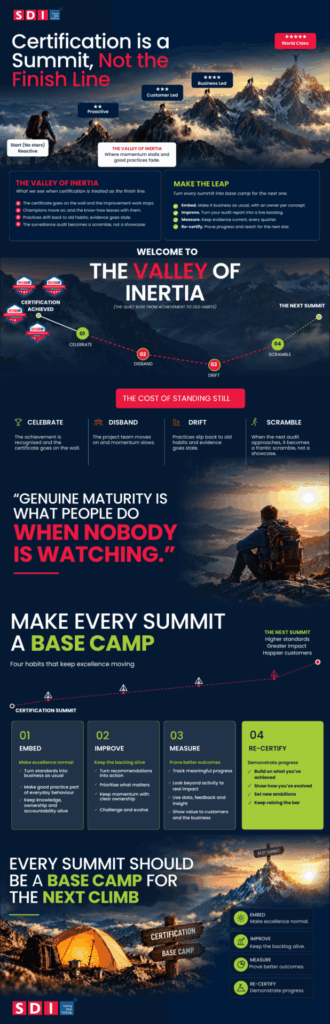
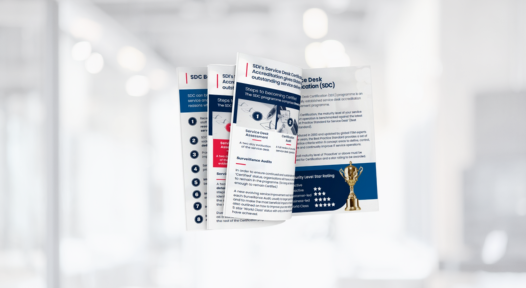
➡️ Click to View Full Infographic
The Four-Star Trap
Imagine your service desk has achieved an outstanding four-star certification rating. Fantastic. You’ve demonstrated a high level of maturity, capability and performance. But now what? Do you spend the next few years protecting that rating, or use it as the foundation for something even better?
Maintaining excellence is not the same as advancing excellence. Of course maintaining standards matters, hugely. But if our ambition becomes simply to remain where we are, aren’t we effectively deciding that we’ve improved enough?
I’m not sure I’ve ever met a customer who said: ‘Please don’t improve your service any further. It’s quite good enough already.’
Certification should create confidence in what we’ve achieved while encouraging curiosity about what we could achieve next. Sometimes that means challenging practices that helped us achieve certification in the first place. Because even best practice has a shelf life.
Why You Should Make Every Summit a Base Camp
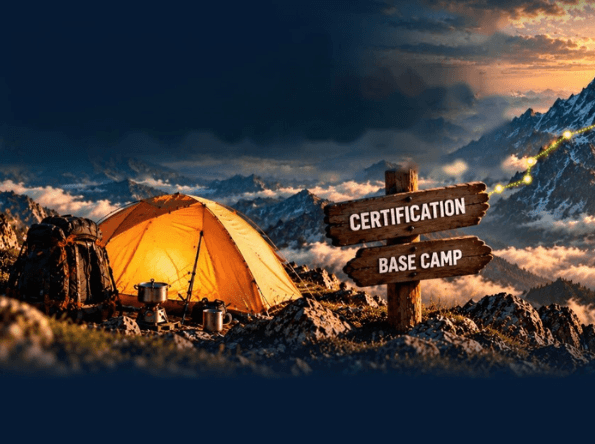
What do I mean by that? You should stop thinking of certification as the destination and start thinking of it as base camp. A place where you can take stock, recognise achievements, learn from the journey and prepare for the next challenge.
#1 Embed: Make Excellence Normal
Ensure the practices that helped you achieve certification become part of everyday operations. Not something people do because an auditor is coming, or because a manager is watching, and certainly not something that exists only in a beautifully formatted process document.
Genuine maturity isn’t demonstrated by what people do when they’re being assessed. It’s demonstrated by what they do when nobody is watching.
#2 Improve: Keep the Momentum Alive
One of the most valuable outputs from a certification assessment isn’t necessarily the rating. It’s the understanding of where you can go next. Every recommendation, observation and improvement opportunity is potentially another step up the mountain.
You should never let that assessment report gather digital dust. Instead, turn it into a living improvement plan you can use. Give people ownership. Set meaningful priorities. Track progress and challenge assumptions. And please, don’t create a 200-line spreadsheet that needs its own improvement project just to understand it. It’s always good to keep it practical, visible, and keep it moving.
#3 Measure: Prove Things Are Better
I have a particular dislike for improvement initiatives declared successful simply because somebody completed the actions. ‘We’ve updated the process.’ Wonderful. Has it made anything better? ‘We’ve delivered the training.’ Excellent. Has behaviour changed? ‘We’ve implemented a new tool.’ Fantastic. Has the customer experience improved?
Completing an activity is not the same as delivering an outcome. Efficiency and productivity matter, but so do customer sentiment, employee experience, business outcomes and the quality of the relationships we’re building.
The question isn’t simply whether we’re doing things better. It’s whether we’re making things better!
#4 Re-certify: Demonstrate Progress
Re-certification shouldn’t be an exercise in proving that nothing has deteriorated. It should be an opportunity to demonstrate how much further you’ve travelled.
What’s improved? What have you learned? What have you stopped doing because it no longer adds value? What have you introduced because your customers’ needs have changed? And what ambitions have you developed that you didn’t have at your previous certification?
That’s what makes the next assessment exciting. Not defending yesterday’s achievement. Demonstrating tomorrow’s potential.
The Summit Is Moving Anyway
There’s another reason why standing still is such a dangerous strategy. If you’re standing still, the mountain itself is changing. Think about the service desk of just five years ago. Now think about what AI, automation, self-service, digital experience management and changing customer expectations are doing to our industry.
This means that traditional measures of service desk success are being challenged. The nature of human support is evolving, and the skills we need are changing. Also, the distinction between providing technical support and delivering genuine business value is becoming increasingly important.
If you look at an organisation that achieves certification and then stands still, that doesn’t mean it’s simply maintaining its position. Today, standing still can mean falling behind. So, the continual improvement everyone talks about isn’t just a nice aspiration. It’s essential.
Enjoy the View, But Then Keep Climbing
I absolutely believe organisations should celebrate achieving Service Desk Certification. It’s a significant accomplishment. It requires commitment, collaboration, leadership and a genuine willingness to examine how things are done. Anyone who’s been through the process knows it isn’t always comfortable.
You’ve earned the view from the summit. Enjoy it. Recognise the people who helped you get there. Take the photographs. Put the certificate on the wall. Have a celebration. You might even deserve a cake.
But when Monday morning arrives, don’t ask how you’re going to protect the certificate. Ask how you’re going to build on everything it represents.
The most successful service desks aren’t necessarily those that reach the highest summit first. They’re the ones that never lose the desire to climb.
And whatever your next summit looks like, you don’t have to get there alone.
Whether you’re just starting your service improvement journey or building on an existing achievement, our Service Desk Certification (SDC) programme can help you understand where you stand, identify opportunities for improvement and keep making progress.
➡️ Explore Service Desk Certification