


 Back to Resources
By Emma Spear, Chief Experience Officer, SDI
If you lead IT, your board or executive team is probably asking some version of the same question: what are we doing about AI? The pressure is to answer with a platform, a pilot or a policy.
Those answers matter, but they assume something that often isn’t true yet: that the service operation underneath is ready for AI to work on top of it. AI doesn’t fix a knowledge base nobody trusts, a ticket history full of “resolved – see notes”, or a team unsure what its role looks like next year. It amplifies whatever is already there, weaknesses included.
For CIOs and senior ITSM leaders, that is an investment risk. For service desk leaders, it is a daily reality: they are usually the first to see whether the foundations will hold. Both need the same thing before committing budget or reputation: an honest view of how ready the service desk is, today, for AI to make it better rather than faster at getting things wrong.
What AI readiness actually means for a service desk
AI readiness isn’t a technology score. It’s whether the foundations an AI tool depends on are in good enough shape to be built on. For most IT service and support teams, that comes down to five things.
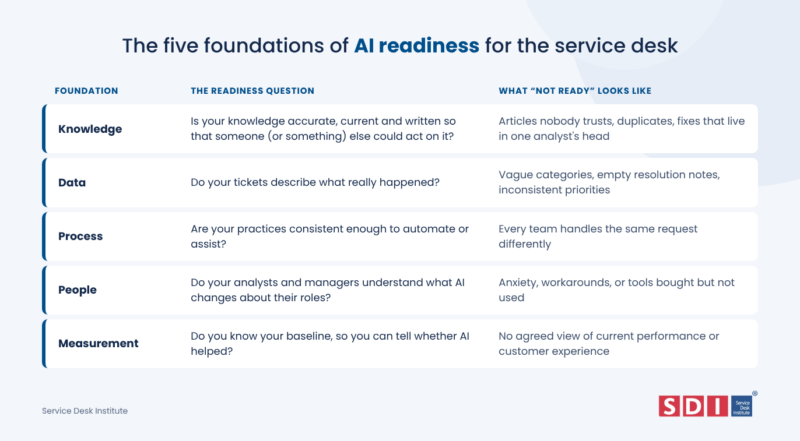
None of these are new disciplines. They are the fundamentals of good service management, and they usually sit with the service desk leader. AI simply raises the cost of getting them wrong, and that cost lands on the CIO’s budget.
Not sure which of these would hold you back? John Noctor, SDI’s Chief Customer Success Officer, works with service desks on exactly these questions. Book a conversation with John to talk through where your foundations stand.
Why readiness comes before implementation, governance and use cases
Implementation, governance and use cases all matter. But each is cheaper, faster and less risky when it rests on an honest view of readiness.
- Implementation goes faster when the knowledge and data the tool will draw on are already clean. Otherwise the project quietly becomes a clean-up exercise with a licence fee attached, and the business case slips.
- Governance is more practical when you know where the real risks sit: in the content AI will surface, the decisions it will touch and the people who will rely on it. That is what boards and auditors will ask about.
- Use cases are easier to prioritise when you can see which parts of your service are mature enough to benefit, and which would only expose their own gaps in front of customers.
- Value is only provable if you know your baseline. Without one, nobody can say whether the investment worked.
Readiness is also the part vendors are least well placed to help with. A supplier can tell you what its product can do. It is harder for it to tell you, impartially, whether your service operation is ready for any product at all.
AI readiness in practice: Runshaw College
The IT Services team at Runshaw College, which holds 5-star SDI Service Desk Certification, shows what happens when AI lands on ready foundations. Some of its ideas came directly from a workshop held as part of its SDI certification audit, which helped the team step back from individual tools and ask where AI could reduce friction and free people for work that needs human judgement.
The team now uses an AI agent, Bobbie, built on Microsoft Copilot and Jira Automation inside its existing processes and controls. Bobbie categorises and assigns incoming tickets, improves titles and writes short summaries. Every result is reviewed by a person, and Service Desk Team Leaders control the rules.
September, one of the team’s busiest months, showed the result:
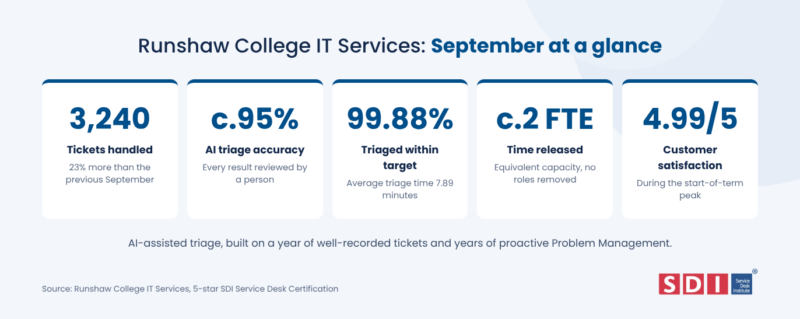
The released time didn’t remove anyone from the process. It meant more time helping customers at the start of term.
What made it work was readiness, not the tool. Look closely and the groundwork is everywhere:
- Data: the triage model was trained on a full year of previous tickets. That only works if those tickets were categorised and recorded well.
- Process: the team has run proactive Problem Management for years. Incidents fell from 50.6% of Service Desk tickets in 2016/17 to 8.0% in 2025/26, and the team is careful not to credit that to AI, which is new. AI now spots recurring patterns, but people decide whether a problem exists.
- Governance: Bobbie reviews proposed changes as a “critical friend” before CAB, but it doesn’t approve anything. The College’s AI guardrails apply throughout, and more sensitive work involving student data has been through a DPIA and cyber risk analysis.
- People: the team uses a simple shared language, the “6Cs” (Creation, Curation, Clarification, Cognition, Communication and Coordination), to explain what AI is doing in each process.
- Measurement: accuracy, triage time and satisfaction were all measured, so the team can show what changed.
As the team puts it: where AI helps, they build on it. Where it doesn’t, they stop, adjust or try a different approach.
There is a lesson here for both levels of leadership. For a CIO, the story is released capacity, measurable service gains and a governance position that can be explained to a board. For a service desk leader, it is a reminder that the work that made AI possible (clean data, disciplined processes, a team that understands the tools) was service desk work, done long before the AI arrived.
Want to know how your service desk compares? Talk to John Noctor about what Runshaw’s groundwork looked like, and what the equivalent steps would be for your organisation.
A readiness lens from the SDI standard: Concept 10
Version 9.0 of SDI’s Global Best Practice Standard for Service Desk added a new concept: Concept 10, Managing the AI System. It treats AI as a strategic enabler that has to be adopted, implemented and managed responsibly. The standard is clear that AI must not be viewed in isolation, but integrated with people, process and technology.
Like every concept in the standard, Concept 10 is assessed against maturity levels, from Reactive through to World-Class. That makes it a readiness tool as much as a governance one. It also gives CIOs and service desk leaders a shared language: strategy and value at one end (10.1 and 10.12), and the operational detail of data, testing and human oversight in between. Leaders can see where they are today, and what the next level looks like, before committing to any platform.
Here is how Runshaw’s approach lines up with Concept 10’s criteria:
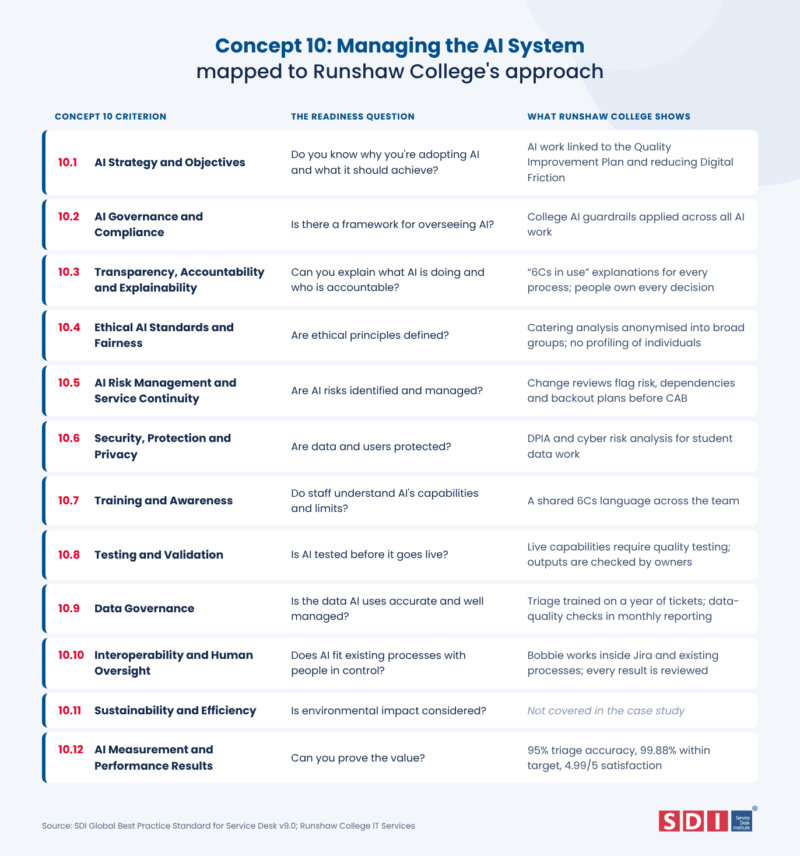
No team will be strong on every line, and this one doesn’t claim to be. That’s the point of a readiness view: it shows you where to focus before you scale.
Where would you sit on Concept 10? Take SDI’s free Service Desk AI Maturity Assessment. It’s 12 questions based on Concept 10, takes five minutes, and gives you an instant score, a star rating and a tailored report. Then talk your results through with John Noctor to agree the one or two areas to focus on first.
How SDI helps IT teams understand their readiness
SDI has set standards for IT service and support since 1988. We don’t sell AI tools, and we don’t have a platform to push. That independence is what lets us help teams look at readiness honestly.
Standards that define what good looks like. SDI’s Global Best Practice Standard for Service Desk gives teams a benchmark for the foundations AI depends on: knowledge, process, measurement and customer experience. Its new Concept 10, Managing the AI System, adds maturity criteria for AI itself. Our Service Desk Analyst standard, now in version 9.0, includes a dedicated Artificial Intelligence section for the first time, so analyst capability around AI can be developed and assessed alongside everything else.
A five-minute AI maturity check. Our free Service Desk AI Maturity Assessment turns Concept 10 into 12 questions. You get an instant score and star rating, plus a tailored report showing where your service desk stands against global best practice.
Benchmarking that gives you a baseline. You can’t tell whether AI has improved your service if you don’t know where you started. SDI’s benchmarking and certification work gives teams an independent view of current performance before they change anything. As Runshaw College found, the audit itself can be where the best AI ideas start.
Training that builds AI readiness in your people. Technology is rarely what holds AI back; confidence and understanding are. SDI’s one-day Future of the IT Service Desk – AI & Automation course helps service desk teams and leaders understand how AI and automation are changing service desk work, so they can prepare their people and processes rather than react to them. It supports the Training and Awareness criterion (10.7) in Concept 10 directly.
Research that shows where the profession really is. SDI’s practitioner research tracks how service desks are adopting technology and AI, so you can compare your own position with peers rather than with vendor case studies.
Events focused on the foundations. Our virtual sessions, including Making Knowledge AI-Ready, bring practitioners and suppliers together on the groundwork rather than the hype.
An independent view of the tools. When you are ready to look at the market, SDI’s first AI Tools Guide (publishing 2 November 2026) sits alongside our ITSM Tools Guide to help you see what is available in one place.
A community that has been there. Through SDI membership and events such as Spark, you can hear from service desk leaders who have prepared for AI, including what they would do differently.
What we won’t claim, and where to start
To be clear about our role: SDI won’t choose your AI platform, write your AI policy or run your implementation. There are good specialists for each of those. What we can do is help you understand whether your service desk is ready for them, and what to fix first if it isn’t.
If you are a CIO or senior ITSM leader:
- Ask for a readiness view before a business case. Before approving AI spend, ask your service desk leader where the operation stands against Concept 10 and the foundations above. The free AI Maturity Assessment gives you a first read in five minutes.
- Agree the baseline now. Decide the handful of measures you’ll use to judge AI’s value, and record where they stand today.
- Back the groundwork. Knowledge and data clean-up is rarely glamorous, but it is what makes the investment pay back.
If you lead a service desk:
- Test your knowledge base. Would you be comfortable with a customer reading any article, unedited, as the answer to their problem? If not, that’s your first readiness task.
- Look hard at your ticket data. If an AI model learned from the last 12 months of your tickets, would it learn the right lessons?
- Build your team’s AI confidence. The people foundation is often the weakest. Our AI & Automation course is a one-day starting point for analysts, team leaders and managers.
- Talk to peers. Join an SDI event or become a free SDI member to compare notes with teams at the same stage.
AI will change IT service and support. The teams that benefit most won’t necessarily be the first to buy. They will be the ones that knew where they stood before they started.
Ready to take an honest look at your AI readiness? Start with the free Service Desk AI Maturity Assessment, then book a conversation with John Noctor, SDI’s Chief Customer Success Officer, to talk through your results.