



 Back to Resources
The IT industry is going through some exciting changes, with AI, automation, and digitalisation really shaking things up in the workplace. This creates both challenges and opportunities for IT professionals looking to future-proof their careers.
But to keep up with emerging technologies, employees must adapt quickly, upskill, and embrace broader responsibilities.
So, there are some important questions we need to ask: Are we doing enough to hold onto our talented professionals and provide the necessary support they need?
The 2025 UK Talent Shortage Survey shows a slight drop in the talent gap, from 80% to 76%, indicating businesses’ efforts are starting to pay off. But fewer job openings are also easing demand, raising concerns about a potential hiring recession. Globally, 74% of employers struggle to find skilled talent.
With a significant portion of IT professionals considering leaving their roles, it’s time to examine whether the industry is keeping pace with employee expectations.
We know talent retention is more than just about pay. It involves worklife balance, job satisfaction, career growth, and wellbeing.
⚡ In this blog, we’ll look at:
- What is employee retention?
- Statistics on what’s keeping employees in their workplace.
- What can organisations do to improve employee retention?
- What does the future hold for worklife in ITSM?
What Is Employee Retention?
Simply put, employee retention is an organisation’s ability to keep its employees over a period of time. It is a key measure of job satisfaction, company culture, and the effectiveness of HR policies.
If we only look at the IT industry, skills shortages are very common, and competition for top talent is often high. This means that retaining employees is becoming even more important to maintaining business continuity and innovation.
What is a good employee retention rate?
A good employee retention rate varies by industry, but a retention rate of 85% or higher is generally considered good in the IT industry. This means that a good employee turnover rate would be around 10%.
Statistics On What’s Keeping Employees in Their Workplace
According to our ‘The Future of Worklife in ITSM’ research in 2023, 42% of IT professionals said they were seriously considering leaving their current roles. What’s more interesting is that the same research found that 72% of IT professionals stated they were happy in their roles, but that doesn’t necessarily mean they plan to stay.
This raises concerns about the long-term sustainability of IT teams and their ability to support businesses effectively.
So, has this changed today?
Based on the ManpowerGroup, Global Talent Barometer, 80% of respondents find meaning in their work today. But a third of UK employees still feel stuck in their careers, with limited chances for growth and a lack of trust in management. As a result, 34% plan to leave their jobs in the next six months.
Interestingly, despite higher wellbeing and worklife balance, 60% of remote workers are likely to change jobs.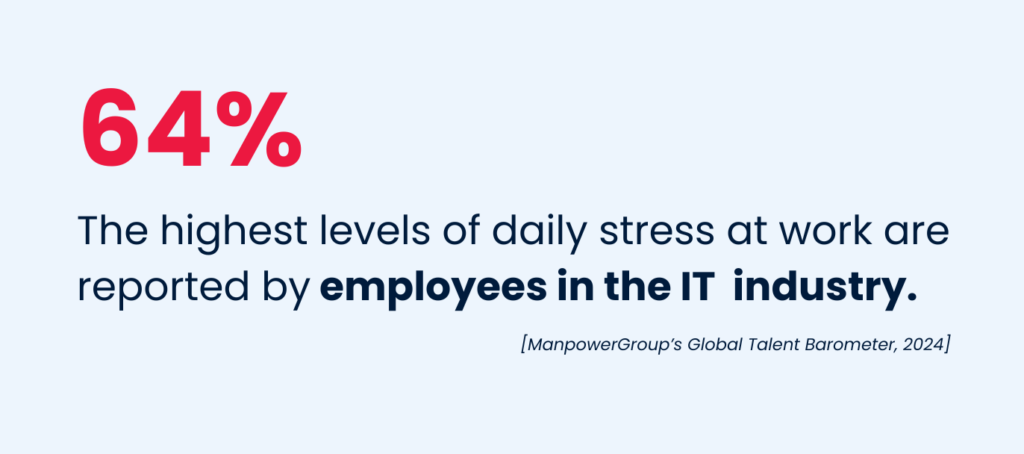
The same report also found that nearly 48% of UK workers experience daily stress at work, with only 24% feeling fully supported by their employer regarding wellbeing. The highest levels of daily stress at work are reported by employees in the IT sector (64%).
This suggests that while some companies have made progress, some are still struggling to prioritise the key motivators for employees in their retention strategies.
So, what really keeps employees in their current roles?
What Can Organisations Do to Improve Employee Retention?
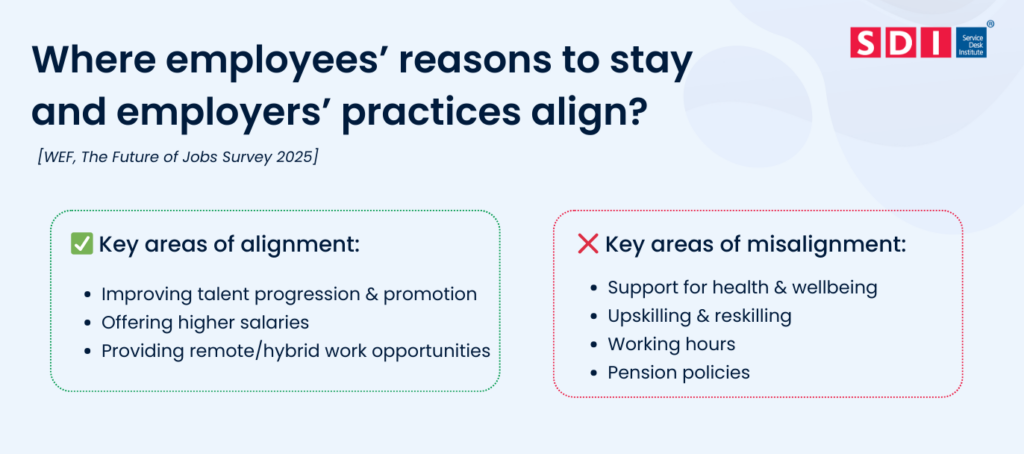
Based on the latest WEF The Future of Jobs Survey 2025, employers are less positive in their ability to retain talent than they were two years ago.
If we look at the employer perspectives from the Future of Jobs Survey and employee insights from ADP Research, there are key factors influencing talent retention and attraction.
The findings reveal both areas of alignment and misalignment between employers and employees.
✅ Key areas of alignment:
- Improving talent progression & promotions: Both employers and employees consider this very important for retention and talent attraction.
- Higher salaries: Employers understand that offering higher pay is essential to attracting and keeping skilled workers, while employees see fair compensation as a fundamental reason to remain in a job.
- Remote/hybrid work: Businesses acknowledge that offering flexible schedules helps retain talent and improves job satisfaction. At the same time, employees increasingly expect the ability to work flexibly as part of a modern work environment.
❌Key areas of misalignment:
- Support for health & wellbeing: Employers consider workplace wellbeing initiatives essential for maintaining a productive workforce, but employees do not view them as the main factor in their decision to stay in a job.
- Upskilling & reskilling: Employers view continuous learning as vital for staying competitive, but employees are not prioritising it on the same level. This might suggest that employees may either not see immediate personal benefits of upskilling or reskilling or prefer direct career advancement opportunities over additional training.
- Working hours: Employees place high importance on flexible working hours, while many employers do not see working hours as a primary factor in keeping employees engaged.
- Pension policies: This misalignment suggests that businesses may be underestimating the importance of financial stability in employees’ long-term career decisions.
To improve talent retention, organisations should adopt a more people-centric approach. This means adopting strategies that bridge the gap between employer priorities and employee expectations, ensuring policies align with what truly matters to the workforce.
Here are some of the strategies that can improve employee retention:
- Enhancing worklife balance – Employees truly value flexibility in how and where they work. So, offering flexible schedules, performance-based metrics, mental health support, and autonomy in how work is done can help create an environment in which employees want to be a part.
- Investing in career development – Ensuring clear long-term pathways for growth, supporting mentorship programmes, upskilling, and reskilling initiatives that can help employees see a future within the company.
- Fostering a positive work culture – Giving employees a voice at any time, recognising, and rewarding success and nurturing ethical leadership can improve job satisfaction.
- Balancing AI implementation – Ensuring that automation supports employees rather than replacing them can reduce uncertainty and improve employee engagement.
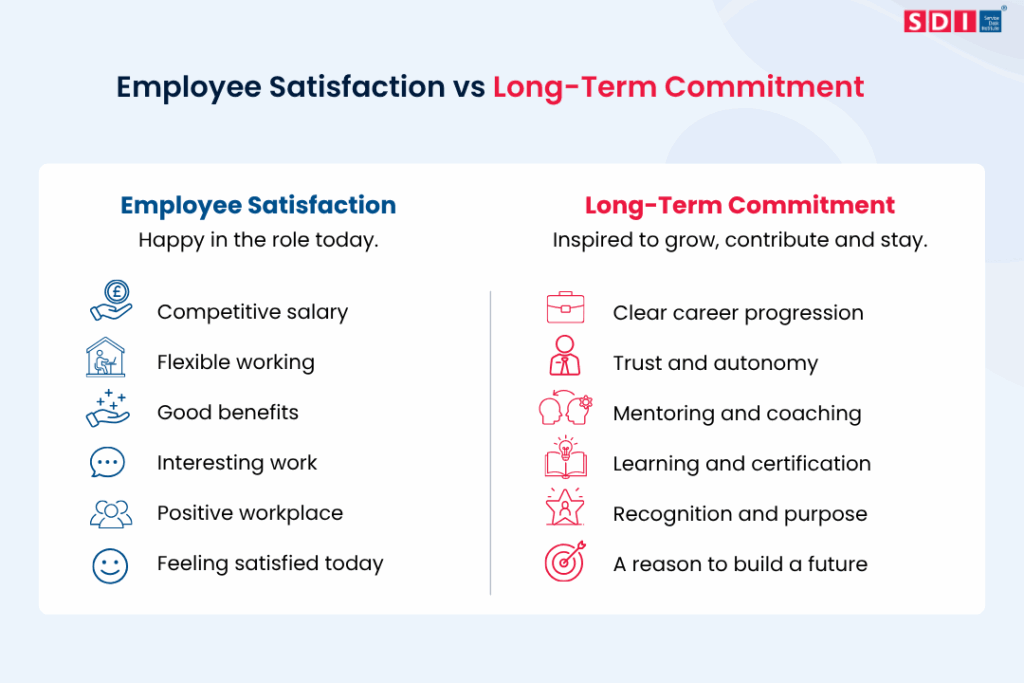
How IT Leaders Can Turn Employee Satisfaction into Long-Term Commitment
The IT industry is at a critical point in talent retention. Even though a good percentage of IT professionals talk of a high rate of job satisfaction, a good percentage of them are still seriously thinking of quitting their jobs, which is caused by unending demands, skill shortages, and the need to constantly keep up with changing technology. This leads to an expensive process of recruitment, onboarding, and knowledge loss, which immediately affects service quality, customer satisfaction, and IT teams’ capacity to innovate.
The key to bridging the gap between being happy in the role and committed to staying is for employers to look beyond the superficial benefits and focus on long-term, people-centred approaches that make IT careers sustainable, valued and future-proof.
What encourages IT professionals to stay
It is required that IT leaders resolve structural and cultural issues of employee experience to address these challenges. Market-oriented competitive salaries are needed, but they are no longer a differentiator, as they serve as a base. What is increasingly differentiating is evident career advancement, observable internal tracks, and access to real developmental opportunities, where employees are promoted to new tasks, specialisms, or leadership roles. Flexible and hybrid working is still highly valued, but it should be accompanied by realistic workloads, trust, and autonomy. Only under these conditions can they make a positive impact on retention instead of being a mere stopgap measure.
Invest in people, not just technology
Retention activities should focus on creating an enabling environment for IT professionals. Mentorship programmes, in which less experienced team members are mentored by senior team members, can offer guidance, motivation, and a sense of direction. The message that the organisation is not only investing in tools and processes but also in people is supported by structured learning plans with time set aside for training and certification. Problem-solving, collaboration, and regular, honest recognition of customer impact would make employees feel visible and valued, not just through ticket performance or SLAs.
To managers, even minor steps can make a disproportionate difference: holding regular development meetings, focusing not only on performance but also on wellness, and engaging team members in decisions about new tools, automation, and new ways of working.
Turnover, engagement and development activity data can also be processed with the help of visualisation to make the case for change, either with the help of an internal dashboard, using simple charts where intent to leave and satisfaction are compared, or with the help of stories that help relate retention efforts to actual improvements in the service outcomes.
This section can be used to direct readers who may wish to learn more about IT career paths, training and certification, integrating work-life balance into IT service settings, and how contemporary leadership contributes to the development of psychologically safe and engaging workplaces. All these reinforce the message that retaining IT talent is not a single project but a lifelong undertaking- one that is mutually beneficial to the employees, customers and the overall organisation as well.