



 Back to Resources
An IT Service Delivery Manager is responsible for making sure IT services are stable, responsive, measurable and aligned with business needs. The role sits at the point where operational delivery, customer experience, service improvement and stakeholder management come together, making it central to high-performing support organisations.
What The Role Means
An IT Service Delivery Manager leads the day-to-day performance and continual improvement of IT services, often across service desk, support, supplier and experience layers. In practice, the role is accountable not just for operational outcomes, but for how well services support users, employees and the wider organisation.
In mature organisations, the role also acts as a bridge between service operations and service strategy. That means balancing service levels, cost, risk, customer expectations, team capability and long-term improvement priorities rather than focusing only on ticket volumes or short-term fixes.
Core Responsibilities
The scope of an IT Service Delivery Manager usually spans several service management disciplines:
Incident management
🔹Overseeing major incident response and escalation paths.
🔹 Making sure incidents are prioritised correctly, resolved quickly and reviewed properly.
🔹 Spotting recurring issues in incident data and escalating them into structured improvement activity.
Change management
🔹 Supporting safe, well-governed change across live services.
🔹 Working with change stakeholders to balance speed, risk and service continuity.
🔹 Ensuring service teams are ready for change through communication, training and knowledge transfer.
Problem management
🔹 Turning repeat incidents into root-cause analysis and long-term fixes.
🔹 Coordinating with technical teams, suppliers and service owners to remove failure points.
🔹 Using trend data to reduce avoidable demand and improve service resilience over time.
Enterprise service management
🔹 Extending service thinking beyond IT into HR, facilities, finance and shared services where appropriate.
🔹 Helping teams standardise workflows, reporting and experience measures across service functions.
🔹 Supporting a joined-up service model that is easier for users to navigate and trust.
Customer and employee experience
🔹 Monitoring satisfaction, experience feedback and service pain points.
🔹 Working with service desk leaders to improve communication, empathy, expectation setting and journey design.
🔹 Making sure service quality is defined by outcomes and experience, not just speed.
Tools They Rely On
An effective IT Service Delivery Manager depends on a mix of operational, analytical and experience-led tooling.
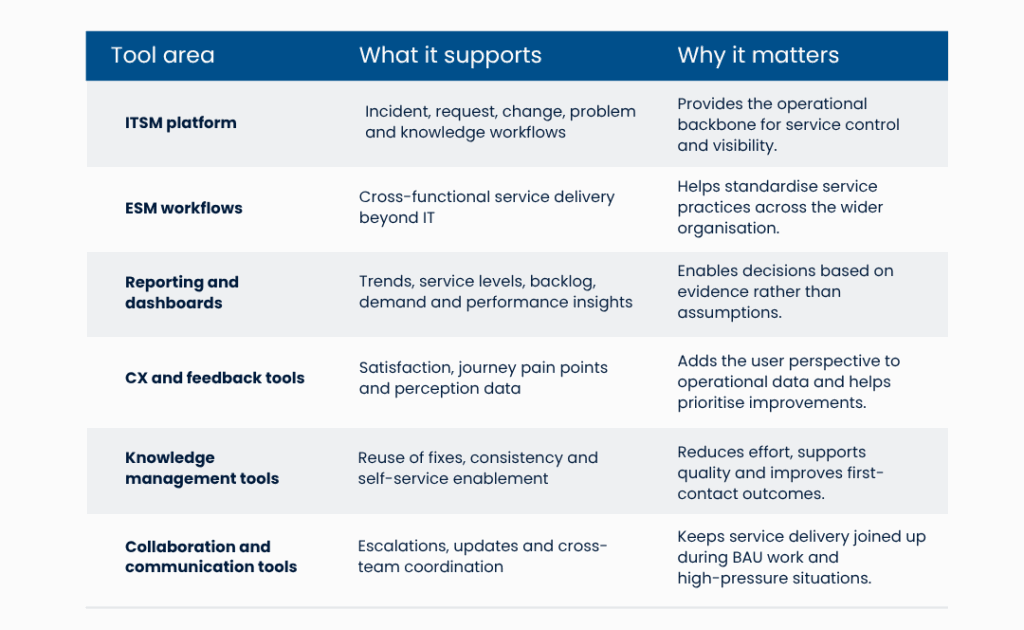
The best Service Delivery Managers do not rely on tools alone. They use tooling to create visibility, discipline and consistency, but pair it with coaching, governance, stakeholder communication and a strong improvement mindset.
Success Metrics
Strong performance in this role is usually measured through a combination of operational, experience and improvement indicators rather than a single dashboard number.
Typical KPIs include:
🔹 Incident response and resolution performance.
🔹 Backlog health and ticket ageing.
🔹 Change success rate and change-related disruption.
🔹 Problem resolution and reduction in repeat incidents.
🔹 Customer satisfaction and employee experience signals.
🔹 Knowledge usage, self-service success and channel shift.
🔹 Service level attainment, reporting quality and trend visibility.
🔹 Progress against service improvement plans and maturity goals.
A useful rule is to balance efficiency metrics with quality and outcome measures. Fast resolution matters, but so do trust, clarity, stability, customer effort and whether the same issue comes back next week.
Capability Model
An IT Service Delivery Manager role often develops through clear stages of capability rather than a simple title change.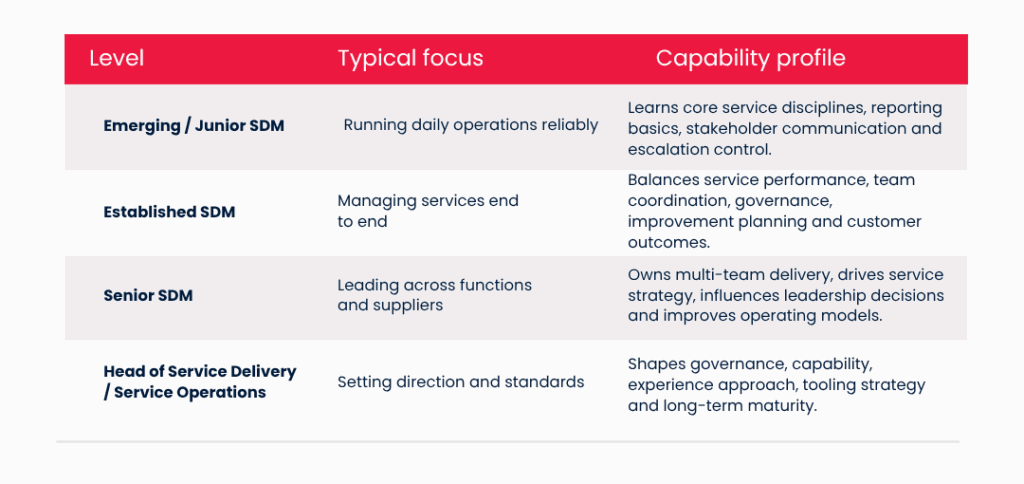
Progression usually depends on increasing strength in five areas: operational control, commercial and stakeholder awareness, data literacy, people leadership and continual improvement. As the role matures, the expectation shifts from managing activity to designing better services and proving value to the business.
Typical Career Paths
Many people move into IT Service Delivery Manager roles from adjacent operational and service leadership positions. Common routes include:
1️⃣ Service Desk Analyst to Team Leader to Service Desk Manager.
2️⃣ Major Incident Manager or Problem Manager into broader service delivery leadership.
3️⃣ Service Desk Manager into Service Delivery Manager, then Head of Service Delivery or Service Operations.
4️⃣ ITSM process roles, supplier management or customer experience roles moving into integrated service leadership.
That makes the role a natural next step for professionals who already understand live support environments and want broader responsibility for service quality, governance and improvement.
How SDI Supports The Role

SDI provides several routes that support the development of Service Delivery Managers and the teams they lead.
Training And Professional Development
As a provider of service desk, customer experience, reporting and service management courses, SDI provides a range of courses for current and aspiring service desk managers that are relevant to their roles. The Service Desk Manager Certification Course is for current and future managers and offers structured development in service desk leadership and best practices.
SDI qualifications and training also benefit teams early in the capability journey, enabling analysts and frontline professionals to build effective succession plans for supervisory and management opportunities.
Standards And Professional Benchmarks
SDI’s Global Best Practice Standard for Service Desk v9 is a practical approach to mapping service operations to best practice and measuring maturity. The standard is the foundation of the Service Desk Certification programme and forms a full maturity model for delivery/operation/management, applicable and relevant to leaders responsible for service performance.
The revised Service Desk Manager Professional Standard also provides service leaders with a competency-based framework aligned with current IT service management practices and ITIL. It is intended to mirror a digital transformation, the customer and modern, tech-driven services.
Evaluate And Identify Areas For Improvement
SDI’s Service Desk Assessment provides a baseline of current performance and assesses the service’s capacity against the Best Practice Standard. It covers leadership, strategy, people, customer experience, and performance results, and provides strengths and weaknesses, along with specific recommendations for improvement. Here’s a quick taster of the Service Desk Assessment. Answer 30 questions and we’ll send you a personalised report. The ‘taster’ assessment questions and scoring align to the SDC v9 concepts and maintain a similar structure and feel to the SDC assessment tool.
Why This Role Matters
The importance of the IT Service Delivery Manager role is that today’s support organisations require more than just operational administration. They require leadership to integrate the process, people, technology, experience and performance into a service model that is consistent, measurable and always improving.
The role falls under one of the most obvious levers for organisations to be more experience-led, future-ready and responsive, thereby improving service outcomes. For people, it’s a high-value progression path that integrates service management discipline with leadership, analysis and customer focus.