


IT Service Management Hub: A Practical Guide to Better IT Services
The management of people, processes, technology & information are coordinated in order to design, deliver, support & continuously improve IT services, called ITSM management. If done correctly, it enables an organisation to deliver reliable services, address issues effectively, make changes safely, and enhance employee and customer experience.
It’s not a software project or tickets. IT Service Management is an operating discipline: Leaders clearly determine which services are important, teams clearly own them, decisions are made based on data, and technology is used to facilitate repeatable work.
What is ITSM Management?
IT Service Management is the hands-on approach of ensuring that IT services are dependable, useful and measurable throughout their entire lifecycle.
🔹This includes responding to questions like:
🔹 What are the services that IT provides and to whom?
🔹 What should users and the business reasonably expect from the level of service?
🔹Who is the owner of an incident, request, change or service?
🔹What is the team’s information need for rapid restoration?
🔹How will leaders be able to tell if improvements are being made with service?
An ‘operational work to business outcome’ approach is adopted from a mature approach. For example, a team is not only tracking closed tickets, they are using ticket, knowledge, asset and customer feedback data to understand why they are seeing an increase in demand. They are identifying where users need help and what changes can reduce repeat issues.
Learn how organisations structure and source ITSM services, what an IT service delivery manager does, and how to choose the right ITSM service desk software.
What IT Service Management Means in Practice
In practice, IT Service Management turns business needs into services that people can understand and use. A typical service-management operation will:
1️⃣ Define services and the outcomes they support.
2️⃣ Publish accessible ways for users to request help or services.
3️⃣ Log, prioritise and resolve incidents and requests.
4️⃣ Control changes so improvements do not create avoidable disruption.
5️⃣ Capture knowledge so teams and users can solve recurring issues faster.
6️⃣ Maintain reliable information about assets, software and configuration items.
7️⃣ Measure performance, learn from failures and prioritise improvements.
The balance matters. Processes that are very controlled can take a long time and can be tedious. On the other hand, processes that are very informal can cause the quality of the performance to vary from time to time.
So, effective ITSM provides the structure for consistent team working. It also allows for the necessary judgment in complex cases.
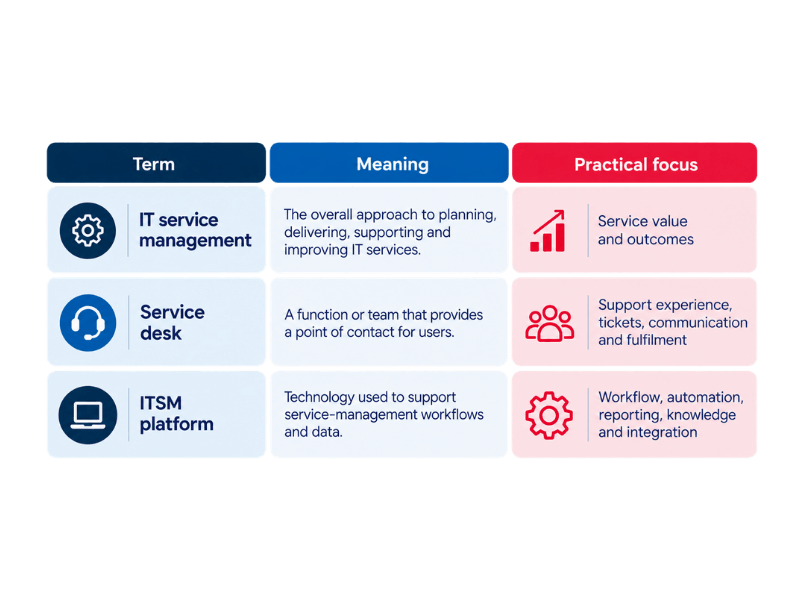
IT service management is the broader discipline of managing IT as a set of services. IT Service Management refers more specifically to the leadership, governance and day-to-day decisions that make that discipline work.
The Core ITSM Processes
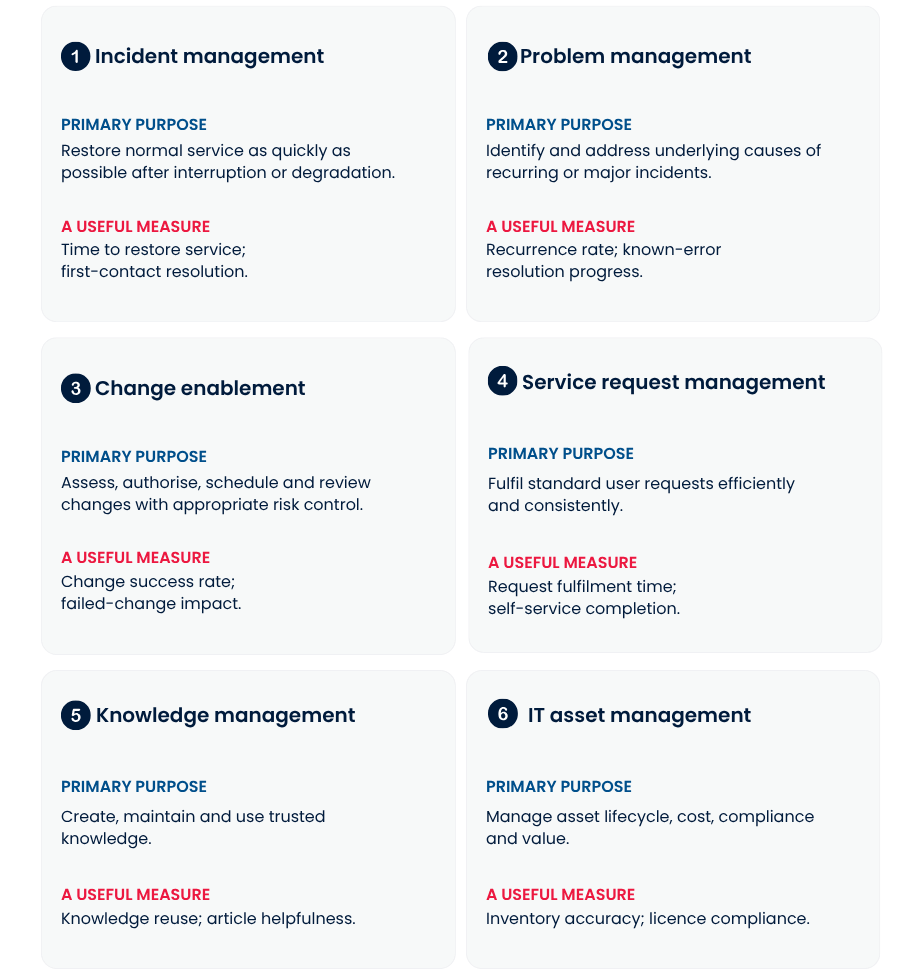
The precise practices and terminology vary by organisation, but these areas form the operational foundation of most ITSM environments.
People, Process and Technology
High-performing service management depends on all three, so they are very important to get right.
People
Individuals must have clear responsibilities, hands-on skills and decision-making power. This encompasses frontline analysts, service owners, technical resolver groups, change authorities, suppliers and leaders. Typically, it is the service delivery manager who brings those groups together and helps to turn service performance into the language of business.
Process
The common path should be made obvious, the exceptional path made safe. Good process design is about what causes work to occur, who is ultimately responsible for each part of the process, what information is needed, when it is escalated and how you know when it has succeeded. No staff should have to go through “unnecessary steps” to please the documentation.
Technology
Technology should make good ways of working easier. It can provide service catalogues, ticket workflows, approvals, automation, knowledge, asset data, dashboards and integrations. Before selecting technology, document the service outcomes and capabilities required.
SDI’s guide to selecting an ITSM tool and ITSM tool-selection and assurance service can support that work.
Frameworks and Complementary Practices
ITIL is widely used as a source of guidance for service management. It helps organisations think about value, service relationships, continual improvement and the practices needed to manage services effectively. It is not a process map that must be copied unchanged.
Other approaches can complement ITIL depending on the organisation’s context:
🔹 Agile and DevOps can strengthen collaboration, feedback and flow between delivery and operations.
🔹 Lean thinking can expose waste, delay and unnecessary hand-offs.
🔹 COBIT can help connect governance and management objectives.
🔹 ISO/IEC 20000 can support a formal service-management system where that is appropriate.
🔹 Security, privacy, risk and resilience practices should be integrated rather than treated as disconnected controls.
Use frameworks as tools for sound decisions. Start with the problem to solve, the risk to manage and the outcome users need.
How to Measure ITSM
The right metrics describe both operational health and customer value. Avoid measuring only what is easy to count.
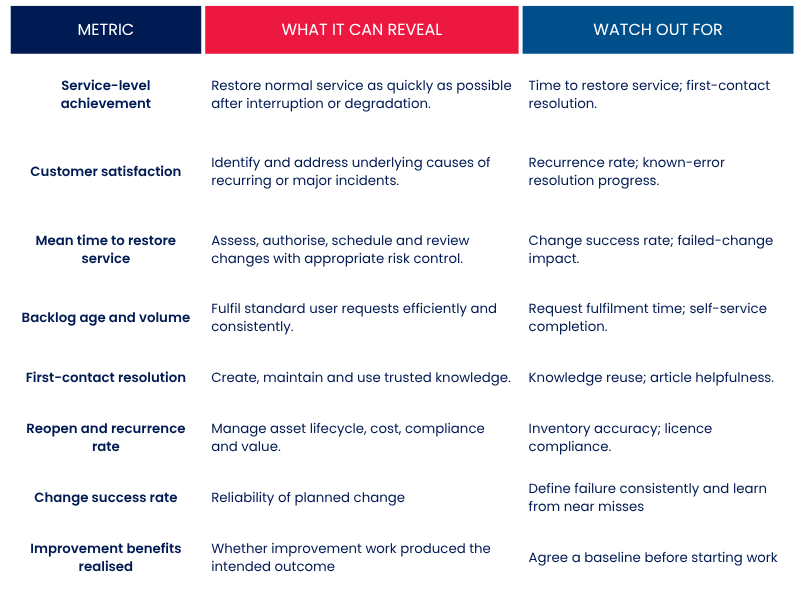
A useful monthly service review combines the numbers with qualitative insight: top user frustrations, repeat-demand themes, supplier dependencies, risk trends and the decisions needed from leaders.
Common IT Service Management Challenges
⭕ Fragmented tools and data
Teams can have their own ticketing, asset, monitoring, knowledge and project work systems. What you get is redundant effort, lacking context, and poor reporting. Begin by determining which information should be made available to workflows and then prioritise the integrations you can make that enhance decisions and/or user experience.
⭕ Weak ownership
If no one has full ownership of the service, problems get passed back and forth. Create owners for services, owners for processes and clear escalation plans. Ownership should come with decision-making rights, not just a name in a document.
⭕ Poor knowledge management
When articles are hard to find, out of date, or written without the user’s task in mind, knowledge becomes untrustworthy. Integrate knowledge creation into incident resolution, understand who has created what and establish clear accountabilities for high-value content.
⭕ Ineffective reporting
Dashboards can generate activity with no insight. Report on decisions: what has changed, why it matters, what risk remains and what action is required. Make use of data quality, don’t just give false precision.
A Practical IT Service Management Maturity Roadmap
A maturity roadmap should improve a real service outcome, not aim for a generic score. Use this sequence.
1️⃣ Understand the current service. Map the most important services, users, demand patterns, pain points and risks.
2️⃣ Set ownership and outcomes. Name accountable service and process owners. Define the outcome each improvement should achieve.
3️⃣ Stabilise the basics. Improve incident triage, request fulfilment, communication, knowledge and escalation before automating complexity.
4️⃣ Improve service data. Establish reliable categorisation, asset/configuration information and performance definitions.
5️⃣ Simplify and automate deliberately. Automate repetitive, well-understood work only after validating the workflow and exception paths.
6️⃣ Review and improve continually. Use service reviews to prioritise improvement work, test benefits and share learning.
Learn more about ITSM Maturity Models
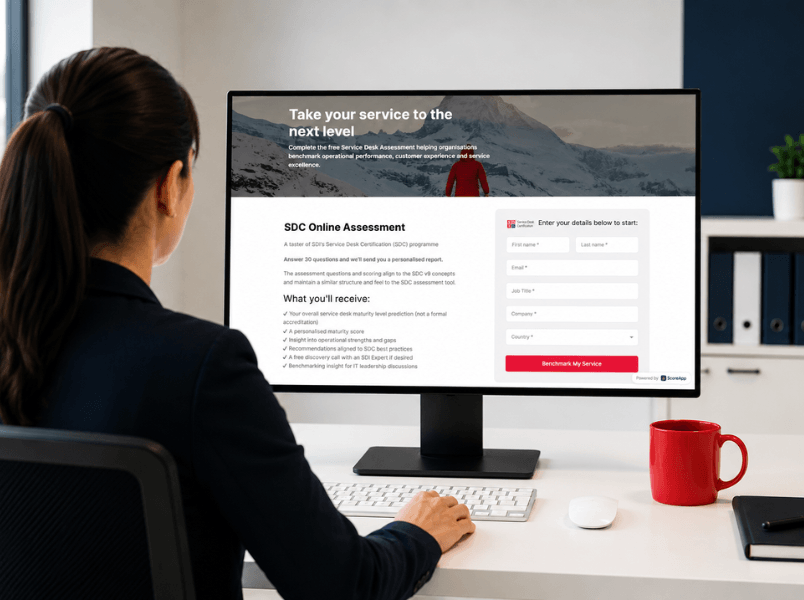
How mature is your service desk?
Understanding your current level of maturity can help you see where your service desk is performing well, where there may be gaps, and where improvement efforts could have the greatest impact.
But judging maturity from inside your own service desk isn’t always easy.
SDI’s Online Performance Assessment gives you a quick way to get a clearer picture. In around 15 minutes, you’ll answer 30 questions about your service desk and benchmark your performance against SDI’s Global Best Practice Standard.
Once completed, you’ll receive a taster report showing your service desk’s rating and predicted maturity level across nine key concepts.
Ready to see where your service desk stands?
Take the free Online Performance Assessment →
Build Stronger Service-Management Capability With SDI
Improving IT Service Management requires sustained learning, practical exchange and the confidence to make better decisions. Explore SDI’s ITIL training, events, resources and membership options to develop service-management capability across your team.
If your immediate priority is a platform decision, read SDI’s ITSM tool-selection guide and use the ITSM tool implementation project plan to move from requirements to go-live.
If you want to talk to us and explore how SDI can help improve your IT service performance, book a free 30-minute advisory session with our Chief Customer Success Officer, John Noctor, focused on your most pressing challenges.
Book A Free ConsultationMore ITSM Guides & Resources
Related ITSM Resources

01.10.26
How to Choose Incident Management Tools
Incident management tools help service teams restore normal service as quickly as possible when something goes wrong. The right platform brings together...
Read More
13.08.26
Advanced Incident Management Tools for IT Support Teams: Features to Consider
We're moving beyond the old days of basic ticket-logging tools. Advanced incident management can now significantly reduce downtime by being fully...
Read More
13.06.25
ITSM Maturity Models: Your Roadmap to Service Excellence
Let’s start with an uncomfortable truth: most IT teams are pushing strategic improvements to the next quarter because they’re busy putting out...
Read More
10.02.26
Comparing Best Free ITSM Software: What IT Teams Need to Know in 2026
Free IT service management tools will provide startups and small IT units with a realistic way to implement structure, accountability, and simple...
Read More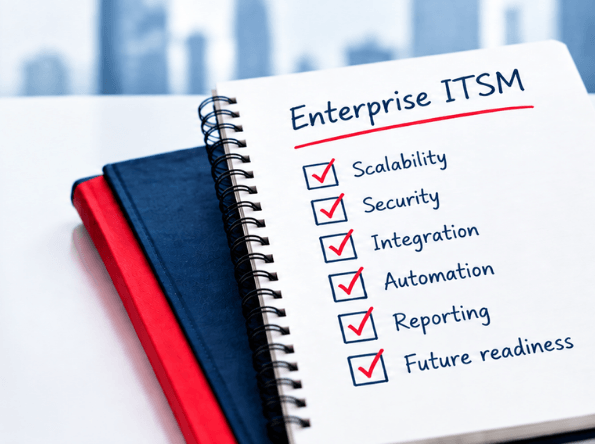
06.10.26
Enterprise ITSM Platforms Worth Evaluating in 2026
Enterprise service desks often support thousands of users, multiple business units and increasingly complex technology environments. At that...
Read More
27.08.26
ITSM Automation Tools: Where to Start, What to Automate, and What to Avoid
Automation is now central to how modern service desks improve speed, consistency and experience. Many ITSM platforms include automation capabilities as...
Read More