



Enterprise service desks often support thousands of users, multiple business units and increasingly complex technology environments. At that scale, it’s not just about logging tickets. It’s about delivering consistent services, automating routine work and maintaining visibility across the organisation.
So, whether you’re replacing an existing ITSM tool or reviewing your current platform, it’s worth looking beyond feature lists and focusing on long-term fit.
We’ve made a list of enterprise ITSM platforms worth considering as part of your evaluation.
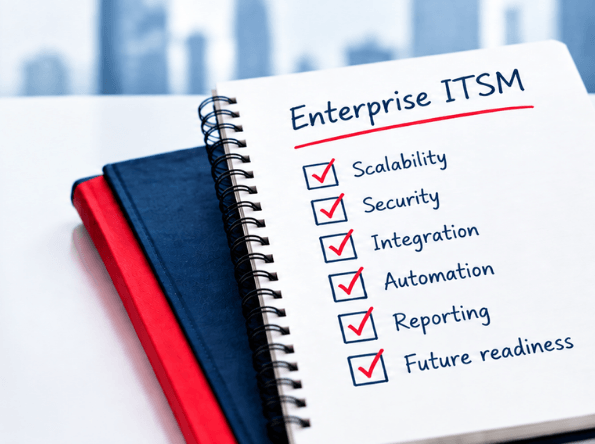
Enterprise organisations often have very different requirements from smaller IT teams. So, before we start comparing platforms, let’s look into what your organisation might need at this scale:
✅ The flexibility to support complex service management processes.
✅ Strong automation and orchestration capabilities to reduce manual work.
✅ Integrations across IT operations, security and business systems.
✅ Governance and reporting to support compliance and informed decision-making.
✅ The ability to scale across multiple teams, departments and locations.
But remember, enterprise ITSM isn’t simply about choosing the platform with the longest feature list. You also need to think about how the platform will work within your organisation. Can it support multiple business units? How will it integrate with your existing technology? What are your CMDB and data requirements? And, importantly, does your team have the resources and expertise to implement, configure and manage it effectively?
For larger organisations, it’s also worth considering areas such as data residency, governance, Enterprise Service Management (ESM) and the resources required to maintain the platform long term.
If you need help with choosing the right ITSM platform, SDI provides independent ITSM tool selection and assurance services.
Gartner-Recognised Enterprise ITSM Platforms
Gartner’s Magic Quadrant can provide a useful reference point when researching the enterprise ITSM market. While every organisation’s requirements are different, these platforms are commonly considered for larger and more complex environments.
ServiceNow
ServiceNow continues to be one of the most recognised enterprise ITSM platforms. Gartner highlights its advanced automation, AI capabilities, governance features and broad support for ITSM, ITOM and employee workflows.
For organisations looking for a platform that can support complex service management across multiple teams and business functions, ServiceNow is often one of the first platforms considered. Gartner does recommend reviewing licensing carefully, as additional capabilities can increase overall costs.
BMC Helix
BMC Helix is aimed at larger organisations with more mature service management practices. Gartner highlights its strengths in change management, configuration management and integration with IT operations, making it particularly relevant for organisations with complex environments or regulatory requirements.
It’s a platform best suited to organisations prepared to invest the time and resources needed for implementation and long-term governance.
Salesforce Agentforce IT Service
Salesforce entered the ITSM market with Agentforce IT Service, bringing together AI, CRM and workflow capabilities within a single platform. Organisations already using Salesforce products may find this an attractive option, particularly if they want to extend existing investments rather than introduce another technology platform.
As the product is relatively new, Gartner recommends considering implementation experience alongside the platform’s capabilities.
OpenText Service Management
OpenText Service Management is designed for organisations looking to combine ITSM with wider IT operations and automation capabilities. Gartner highlights its flexible licensing options and global presence, making it a platform worth considering for larger organisations operating across multiple locations.
As with any enterprise platform, it’s important to assess how well it aligns with your organisation’s long-term service management strategy rather than focusing on features alone.
How to Build a Modern Enterprise ITSM Ecosystem
Choosing an enterprise ITSM platform is only part of the picture. Large organisations often need to connect multiple systems, automate complex workflows and reduce manual effort across different teams and technologies.
That’s why many organisations also invest in supporting technologies that extend the capabilities of their ITSM platform rather than replacing it.
The SDI ITSM Tools Buyer’s Guide 2026–27 features a range of platforms designed to support organisations at different stages of their service management journey.
Here are some of the technologies worth exploring:
ONEiO Managed Integration Service
As enterprise environments grow, so does the number of systems that need to work together. ONEiO helps simplify that challenge by providing a managed integration service, allowing organisations to connect their ITSM platform with other business applications without having to build and maintain integrations themselves.
For organisations with complex technology environments, this can reduce the ongoing effort of managing integrations while helping information flow more effectively between systems.
Resolve
Automation becomes increasingly important as service desks scale. Resolve focuses on autonomous IT operations, helping organisations automate repetitive tasks, accelerate incident resolution and reduce manual intervention across complex IT environments.
For enterprises looking to improve operational efficiency, it can complement an existing ITSM platform by extending automation beyond traditional workflow management.
Kelverion Automation
Many enterprise organisations already have powerful automation tools but struggle to connect them effectively. Kelverion helps bridge that gap by providing automation and orchestration capabilities that integrate with existing enterprise platforms.
Rather than replacing your ITSM solution, it automates repetitive processes and connects workflows across multiple technologies, reducing manual effort and improving consistency.
Other Enterprise ITSM Platforms Worth Exploring
🔷 USU IT Service Management: For complex ITSM and enterprise-wide service management.
🔷 IFS assyst: For mature ITSM and Enterprise Service Management.
🔷 Alemba Service Manager: Good option for complex and highly regulated service environments.
🔷 SymphonyAI ITSM: For organisations exploring AI-led enterprise service management. SymphonyAI is also a Niche Player (new entrant) in the 2026 Gartner MQ.
Finding the Right Fit for Your Enterprise
There’s no single ITSM platform that will be right for every enterprise. Start with your requirements, narrow down the platforms that genuinely fit your environment and use demos and proof-of-concept exercises to test how they work against real use cases.