




 Back to Resources
By John Noctor, SDI Chief Customer Success Officer
What a nationwide outage taught me about mistakes, experience and learning the hard way.
I’ve made mistakes. Loads of them. I’ve made decisions I wouldn’t make today. I’ve trusted the wrong people and, if I’m honest, failed to trust the right ones on occasion.
I’ve pursued ideas that went nowhere and dismissed ideas that turned out to be rather good. I’ve said things I wish I’d phrased differently. And I’ve confidently walked down paths that, with hindsight, had a large sign at the entrance saying “THIS IS A TERRIBLE IDEA.”
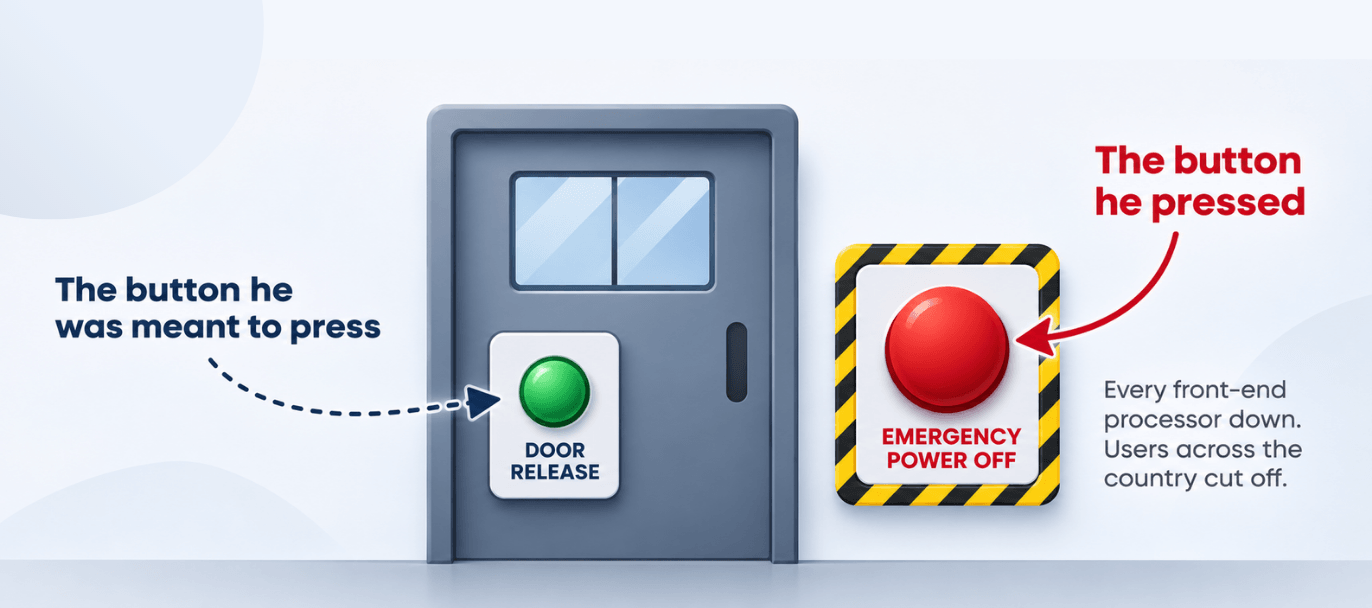
My favourite involved a door.
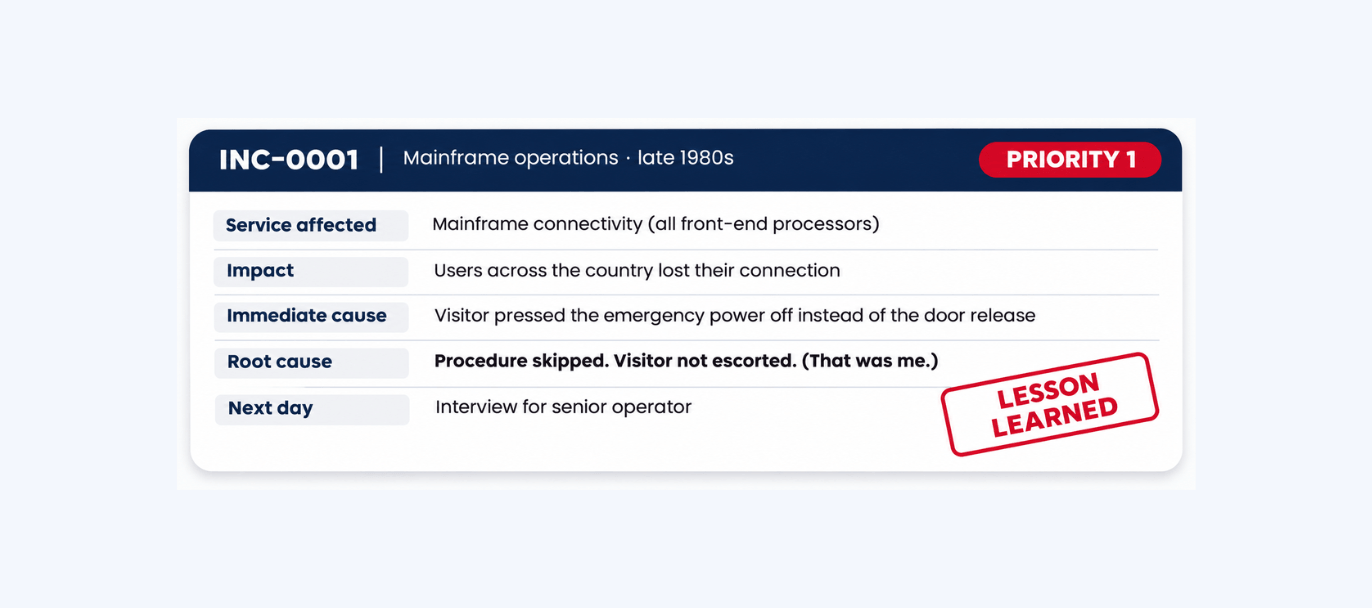
In the late 1980s, I was a mainframe operator at the Central Electricity Generating Board, working in tape setup on the first floor. One day a user phoned with a problem he was having with one of his jobs and its tapes. Try as I might, I couldn’t work out what he was describing.
So I did something that was slightly against protocol. It wasn’t unheard of, but it wasn’t right either. I let him into the tape section so he could show me exactly what he meant.
It worked. I finally understood the problem, and I was keen to get on and fix it. So, rather than escort him out, I told him to press the button on the door to let himself out.
He pressed the button next to the door.
That button was the emergency power-off.
It took out every one of our front-end processors, and users right across the country lost their connection to the mainframe.
I’d been trying to do the right thing. I wanted to help a customer and fix his problem quickly. But good intentions don’t override procedure. Anyone who has worked on a service desk knows that tension: the urge to fix the customer’s problem right now, versus the process that seems to slow you down. More often than not, that process exists because somebody, somewhere, once pressed the wrong button.
And the timing was impeccable. It happened the day before my interview for senior operator.
You can imagine what they asked me about.
Looking back over my career, I’ve realised something.
I’ve learned far more from the things I’ve got wrong than from the things I’ve got right.
That might sound odd, because we spend an enormous amount of time talking about success. Successful projects. Successful transformations. Successful leaders. Best practice. Case studies. Awards.
Nobody rushes onto LinkedIn to announce:
“Exciting news! I completely cocked something up today.”
Perhaps we should, occasionally.
When things go well, we congratulate ourselves, enjoy the moment and move on. When something goes wrong, the questions start:
Why did that happen?
What did I miss?
What assumption did I make?
What could I have done differently?
And, most importantly: what am I going to do differently next time?
Those questions have taught me more about leadership, service, business and people than any course I’ve ever sat through.
Thirty years’ experience, or one year repeated thirty times?
There’s a line I’ve come to believe more with every passing year:
Experience isn’t what you’ve done. It’s what you’ve learned from what you’ve done.
Someone can have thirty years’ experience. Or they can have one year’s experience repeated thirty times. There’s a big difference.
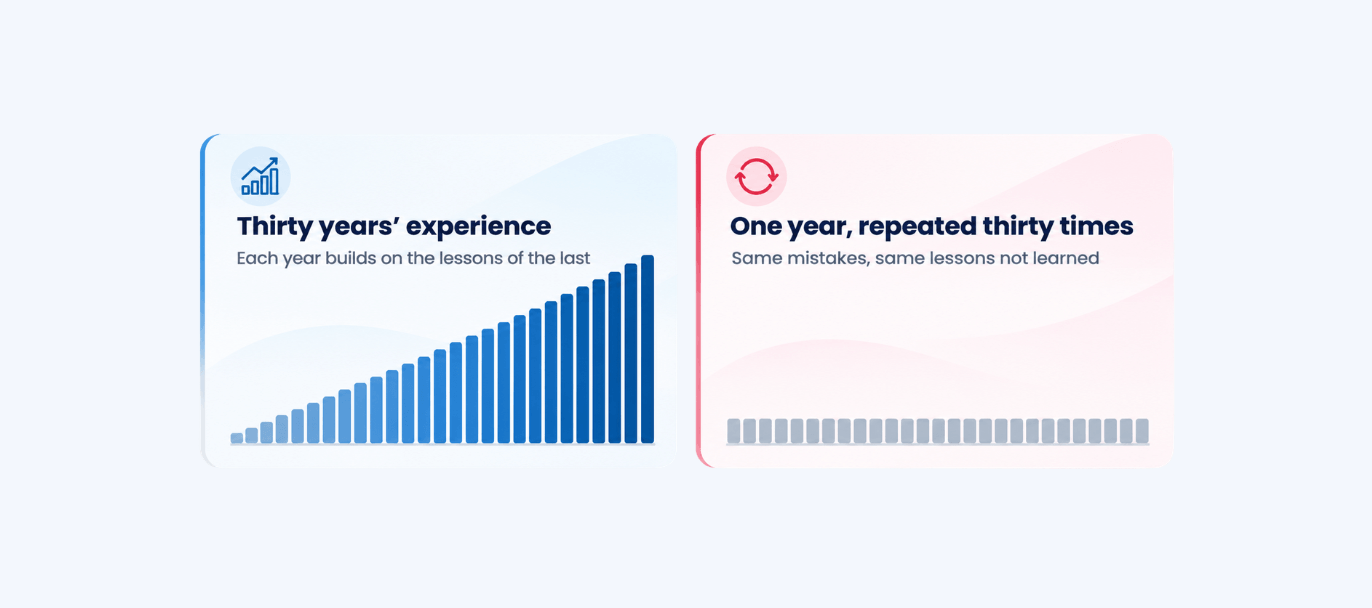
Simply being around for a long time doesn’t make us wiser. If it did, I’d be positively Yoda-like by now.
What matters is whether we reflect. A mistake on its own teaches us very little. Making a mistake, understanding why we made it, being honest enough to own our part in it, and then changing what we do?
That’s experience.
And it requires something that gets harder the more senior we become: admitting we were wrong.
Three words leaders should use more often
I was wrong.
There you go. Nobody exploded.
Leadership sometimes comes with a strange expectation that we should know all the answers. We don’t. I certainly don’t, and I’ve become far more comfortable saying so.
Earlier in my career, I thought leadership meant having the answer. These days, I think it’s about asking the right question — and being willing to change your mind when somebody else has a better answer.
That isn’t weakness. It’s one of the most important things experience teaches you.
If you let it.
But organisations have a problem
Here’s where this becomes bigger than my personal collection of cock-ups.
We constantly tell people we want them to innovate. Experiment. Challenge existing thinking. Try something different. Take calculated risks.
Then something goes wrong, and the mood changes.
Who approved this?
Whose decision was it?
How did this happen?
Cue everybody staring intently at their shoes.
We can’t have it both ways. If we want people to innovate, they will sometimes get things wrong.
That doesn’t mean mistakes come without consequences, or that accountability disappears. And it certainly doesn’t mean repeatedly doing something daft gets rebranded as “innovation”. But there has to be room for what Amy Edmondson calls intelligent failure: a considered risk, taken for good reasons, that didn’t work out.
My emergency power off moment wasn’t intelligent failure, by the way. It was a shortcut. The lesson wasn’t “take more risks”. It was “the procedure is there for a reason, especially when you’re in a hurry to help”. Knowing the difference between those two matters.
In service management, we already know this. It’s why good teams run blameless post-incident reviews, and why problem management exists at all. We’d never accept a service desk that fixes the same incident fifty times without asking why it keeps happening. Yet we often accept exactly that from ourselves as leaders.
The really dangerous employee isn’t the person who makes a mistake.
It’s the person who makes one and then feels they have to hide it.
And the really dangerous organisation isn’t one where things occasionally go wrong.
It’s one where the same things keep going wrong because nobody feels able to talk honestly about what happened the first time.
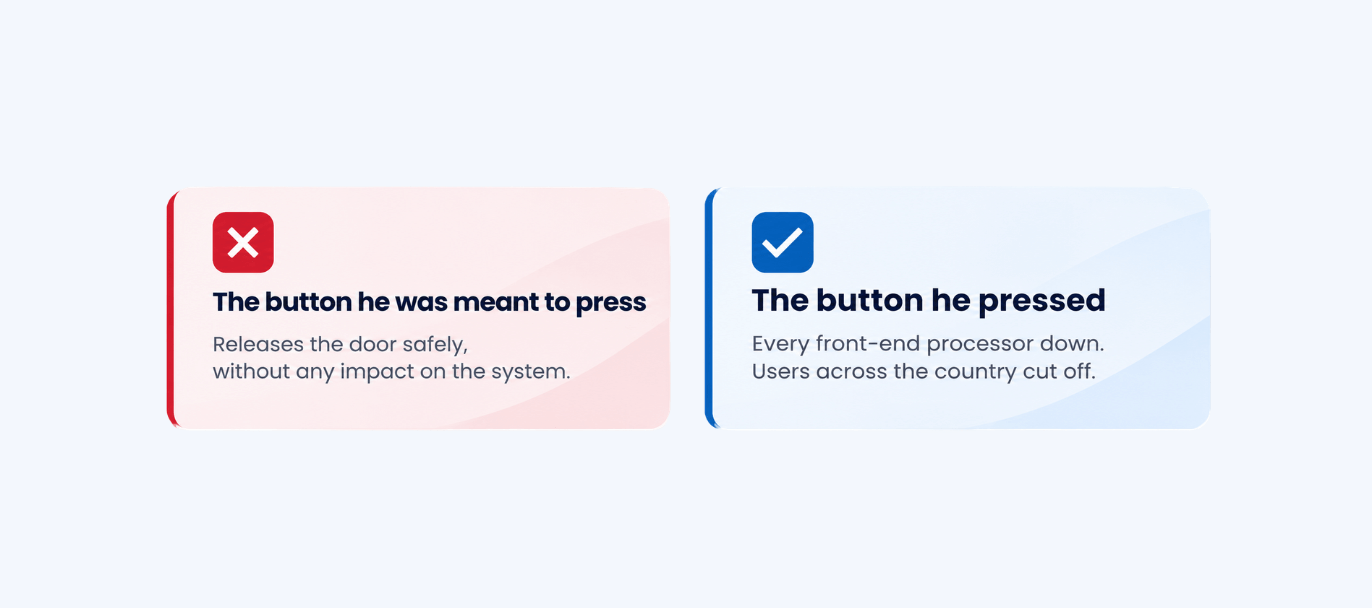
That’s why psychological safety matters. Not because everybody needs to sit around being terribly nice to each other, but because someone needs to be able to put their hand up and say, “That was me. I got it wrong,” and know which of these two questions comes next:
Failure has tuition fees
I’m not going to give you the usual motivational nonsense about failure being wonderful.
It isn’t. Sometimes failure is bloody awful.
It can be embarrassing. It can cost money. It can damage relationships. It can knock your confidence. And occasionally it keeps you awake at three in the morning, replaying a conversation and thinking, “Why the hell did I do that?”
But I’ve started thinking of those moments as tuition fees. Some lessons are cheap. Others are eye-wateringly expensive. Mine came with a nationwide outage and a very uncomfortable job interview.
Once you’ve paid the fee, you might as well take the lesson.
Otherwise, all you’ve done is pay to make a mistake.

I still get things wrong
I wish I could tell you that decades of experience mean I don’t make mistakes anymore. That would be a lie.
I still misjudge situations. I still occasionally think something is a brilliant idea before discovering that it very definitely isn’t.
The difference, I hope, is that I recognise it a little quicker. I’m more prepared to question myself, more comfortable changing my mind, and much less interested in appearing to be right than I once was.
Perhaps that’s what experience really looks like. Not gathering enough knowledge that you stop making mistakes, but gathering enough humility to learn from them when you do.
I don’t want to be remembered as somebody who always got it right. That would require a fairly heroic rewriting of history. I’d rather be remembered as somebody who got plenty wrong, admitted it, learned from it, and became a little better each time.
Because perhaps experience isn’t the accumulation of our successes.
Perhaps experience is the scar tissue left behind by our mistakes.
And if that’s true…
I’ve become extremely experienced.