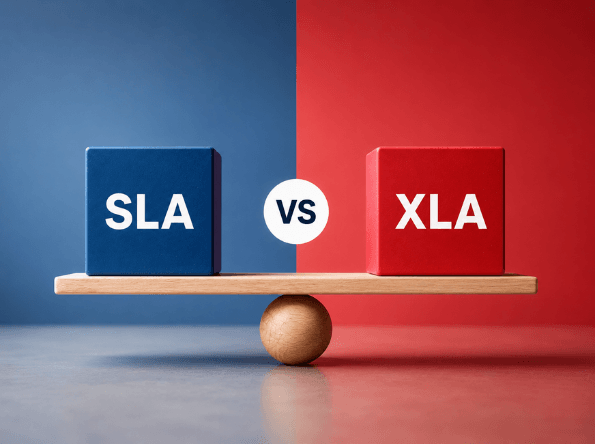





One of the most critical comparisons in today’s service management is SLA vs. XLA. Although both are close cousins, they’re not synonymous, and service desks must grasp the difference if they’re to enhance service performance and the user experience.
An SLA will tell you whether the service reached its target. An XLA provides insight into whether the user found the service helpful, efficient and valuable. The difference is important because a service desk can meet all the SLA’s goals and still make the user mad.
The measure of an SLA
Service Level Agreement (SLA) is the service agreement between business and IT. It typically includes response time, resolution time, uptime, availability and escalation times.
These measures should be considered useful due to their accountability and delivery management. However, they don’t provide a complete picture. A ticket could be resolved within target and still lead to a poor user experience due to poor communication, unclear updates, or a need to chase for progress.
🔗 Download Your Free Service Level Agreement Template
An XLA is used to measure what?
An Experience Level Agreement (XLA) is used to assess the level of experience in using the service. It doesn’t just ask if the user was compliant with the operational procedures; it also asks if the user felt supported, confident and able to get back to work efficiently.
This can include satisfaction, effort, quality of communication, clarity, ease of use, and the business value of the interaction. The service desk environment is an ideal use case for XLAs, as the quality of the interaction is as important as the result.
The key difference
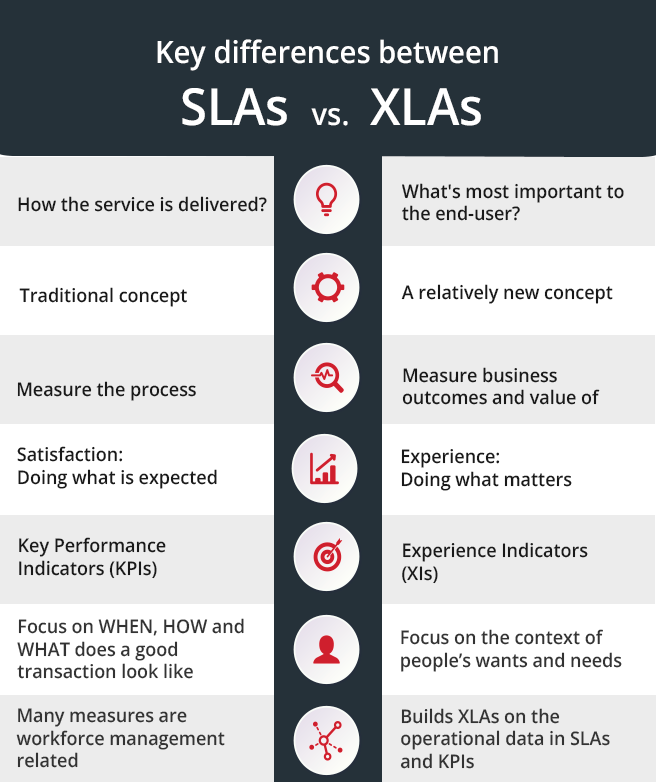
The easiest way to put this is that an SLA is based on delivery, and an XLA is based on experience. SLAs are process- and performance-driven. XLAs are (human and outcome) oriented.
That implies that SLAs ask, “Did we do what we promised?” XLAs question, “Was the service actually good for the user?” Both questions are important, and both indicate different things.
Service desks require a combination of two things.
Service desks should not be interchangeable with SLAs and XLAs. The combination of both is the best model. The operational level is the SLA and the experience level is the XLA.
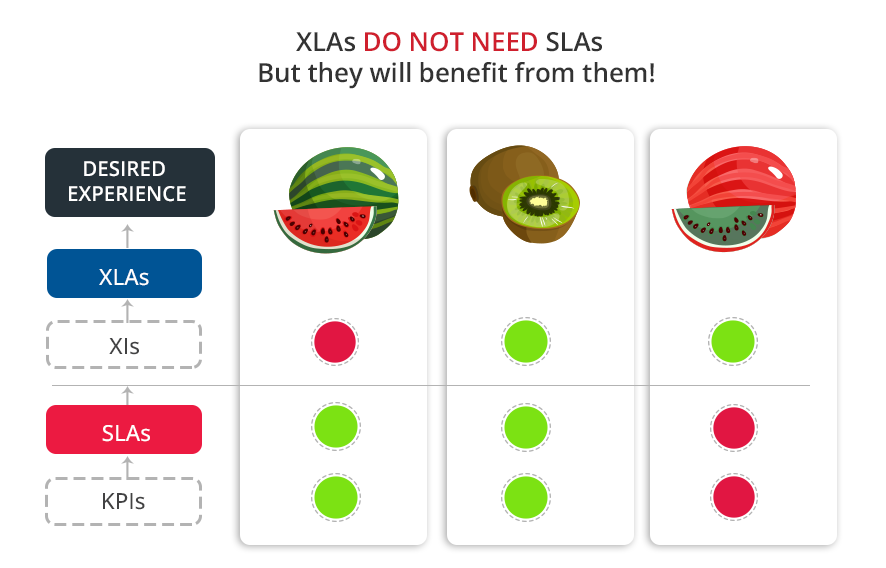
This is particularly significant as a green SLA dashboard can mask bad UX. This is sometimes known as the watermelon effect: good, good, bad. This gap can be identified through XLAs to enable service improvement toward meeting user needs.
SLA examples
Common SLA’s include:
🔷First response time.
🔷Resolution time.
🔷 Escalation times.
🔷 Ticket closure targets.
🔷 Service uptime.
These measures can be helpful for governance and reporting, particularly when a service desk is particularly busy. However, taken in isolation, they can lead to an attitude to speed at the expense of service.
XLA examples
Common XLA requirements are:
🔷 User satisfaction
🔷 Availability of assistance.
🔷 Confidence after support.
🔷 Communication quality.
🔷 The difficulty that the user must overcome to use the system successfully.
These are important because they represent the service desk user experience. They are useful to managers for identifying where the service runs smoothly and where it is causing problems.
How they work together
An optimal practice is to have SLA and XLA measures in the same service journey. For instance, if the SLA is for a password reset procedure, it could be measured by response and completion time, whereas the XLA could be measured by how easy and reassuring the procedure was.
This provides a more comprehensive view. The process can be efficient but not user-friendly if the SLA is good, and the XLA is weak. The experience might be pleasant, but the process might need improvement if the XLA is good and the SLA is weak.
➡️Read more: How To Write An XLA From Scratch
When to use each
When operational control, supplier accountability and clear service commitments are required, use SLAs. When you want to enhance it, stop the user from getting frustrated, get to the root cause of this frustration and link IT support with business outcomes, you should use XLAs.
For most service desks, it is best to have SLA + XLA, not SLA versus XLA. They help to form a more equitable mix of performance, accountability, and experience.
SLA vs XLA is nothing related to old vs new. It’s a decision between measuring only what IT delivers and measuring how IT is delivered. The best way for service desks is to retain the SLA for control and include the XLA for insight.