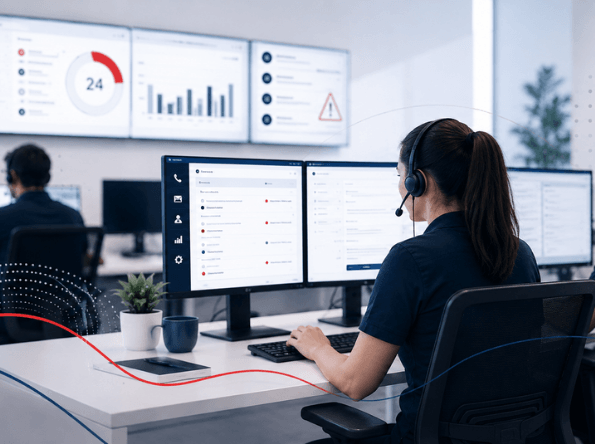


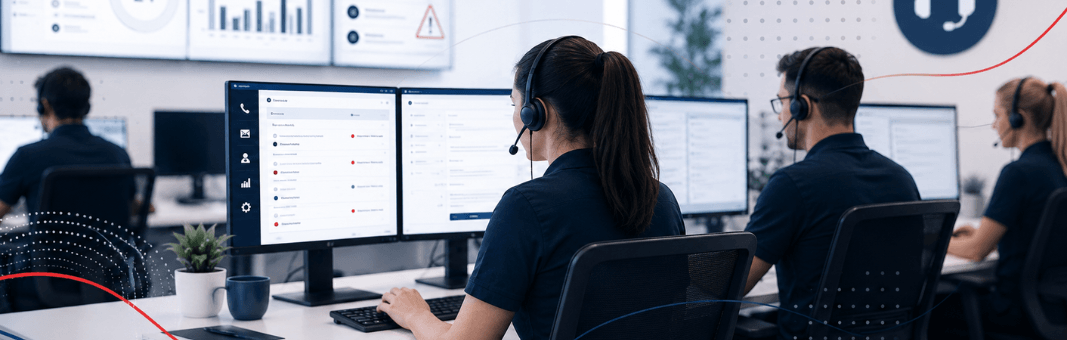

We’re moving beyond the old days of basic ticket-logging tools. Advanced incident management can now significantly reduce downtime by being fully automated and AI-powered, and with strong integrations with other IT tools. So, what does this all means for IT support engineers and managers? Simply put, now more than ever they need to know which features are most important to select tools that will not only enhance response time, collaboration, and root-cause resolution, but also provide a good ITSM integration.
The Importance of Contemporary Incident Management Tools
Modern IT environments are complex, distributed and highly instrumented and they generate lots of alerts every day. So, without effective incident management platform, teams can struggle to prioritise incidents, maintain service quality and deliver a consistent customer experience.
Recent technology is consolidating data into a single workflow, coordinating detection, routing, collaboration, and post-incident learning. This aligns with SDI’s focus on integrated ITSM tooling to enable proper logging, effective communication, and powerful reporting to achieve continual improvement.
To extend the principles of ITSM tool selection to the incident platform (scalability, AI preparedness, integration, analytics), the SDI Comprehensive Guide to ITSM Tool Selection is a good resource.
The Main Features That Any Incident Management Tool Must Provide
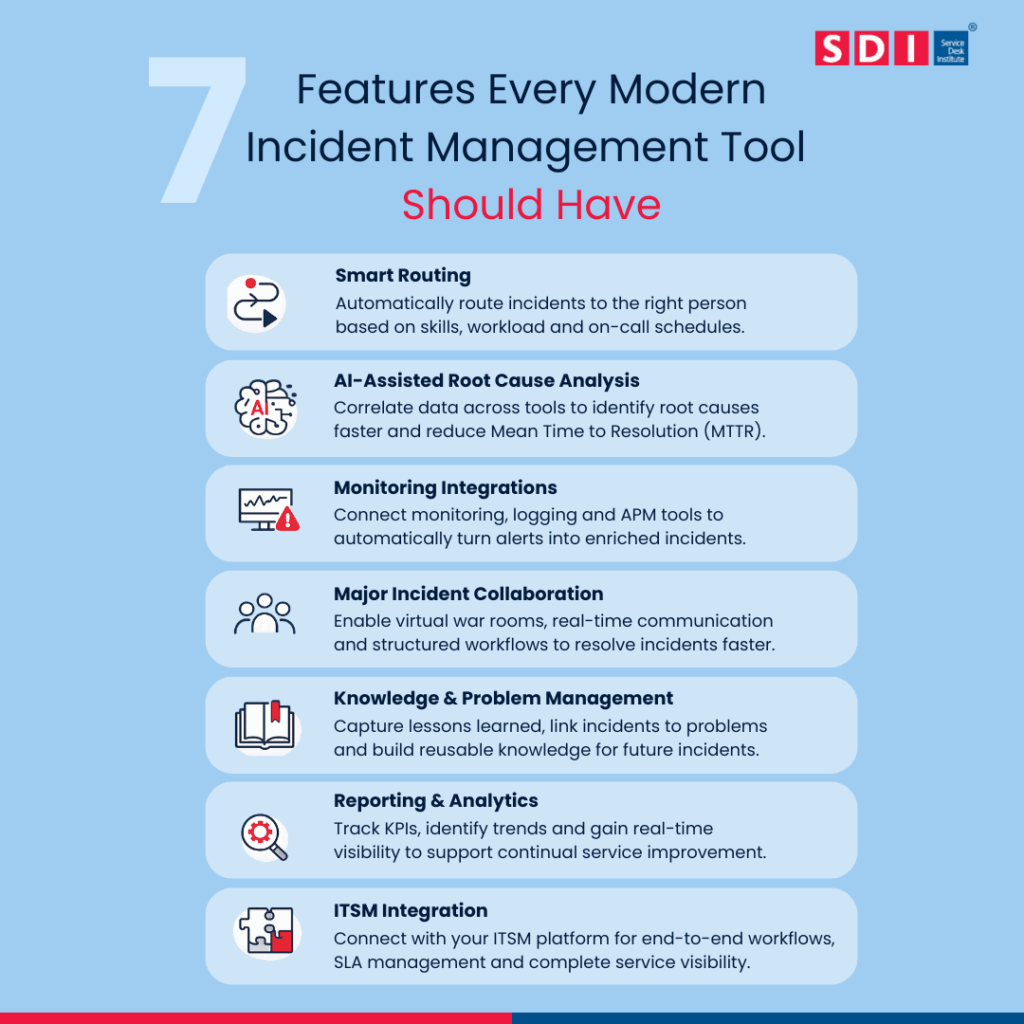
Incident Capture, Normalisation and Routing
At the base, incident tools should be able to reliably capture and normalise information from various sources to ensure engineers can act right away.
These are some of the key capabilities to look for:
🔹Multi-channel intake: Email, portal, chat, phone, APIs, and direct connections with monitoring tools and aggregators of logs.
🔹Automated incident creation: Tie in and collaboration with ITSM and monitoring systems to ensure events create incidents and service requests.
🔹Smart routing: Service, component, priority, skills and on-call schedule-based intelligent routing rules.
🔹Context enrichment: Automatically adding pertinent CI details of the CMDB, recent change, proximate issues, and knowledge articles.
The global best-practice standard of SDI emphasises the need for tools integrated with the monitoring and remote support platforms to enable automatic incident creation and fully capture interactions to monitor performance. It is important to ensure there are no lapses in detection and response, which is achieved through that integration.
Automated Incident Prioritisation and Routing
Manual triage is a bottleneck as the number of alerts increases. The sophisticated tools apply automation and AI to ensure the right work is delivered to the right people at the right time.
Here are some features to prioritise:
🔹 Dynamic assignment: Routing is based on current workload, availability, and on-call rotas to prevent overloading specific engineers.
🔹Impact-based prioritisation: Priority and escalation paths are automatically established based on business services, SLAs, and criticality definitions.
🔹Policy-driven policies: Configure workflows which create notifications, tasks, or significant incident operations depending on the incident type and impact.
🔹Decreasing alert noises: Grouping similar noises and suppressing the ones that have been shown to be duplicate alerts to minimise fatigue and concentrate on real incidents.
More popular ITSM tools, like those featured in its best-practice materials, often support SLAs, business rules, automatic notifications, and support-group-based assignment to facilitate the implementation of structured incident routing.
Root Cause Analysis That Is AI-Powered
AI-aided investigation and root cause analysis (RCA) are considered one of the most potent changes in incident management. Rather than manually sewing together clues made by engineers through logs, metrics, and change histories, AI-driven platforms may:
Create correlations, i. e., between (APM, infrastructure monitoring, logs, change management) to determine probable causes.
Highlight suspicious code deployments, configuration changes, or infrastructure events that coincide with the onset of an incident.
🔹Separate triggers and underlying systemic causes by mapping contributing factors like poor testing or poor ownership.
🔹Develop preliminary RCA drafts and schedules to speed up post-incident evaluation and issue care.
Even vendors like Rootly and Resolve.ai position their systems as “AI SRE teammates who automate investigation, find root cause, and in some cases, even suggest a fix, greatly decreasing the mean time to resolution (MTTR). This aligns directly with the proactive problem management that SDI preaches, in which recurring incidents are brought to the fore and addressed through structured analysis and change.
Monitoring and Observability Tools Integration
Incident tools can never be more effective than their capacity to receive quality signals generated by the rest of your stack. This means that intensive integration with monitoring and logging systems, along with infrastructure management, is no longer a compromise.
Some important aspects include:
🔹Integrations monitoring: Built-in connectors to major platforms (e.g. cloud monitoring, APM, infrastructure and network tools) to convert alerts into enriched incidents.
🔹Bi-directional updates: Bidirectional updates of incident status into monitoring and collaboration systems (e.g. status pages, chat tools) to keep everyone informed.
🔹CMDB and asset linkage: The CMDB and asset database are tightly coupled, with incidents automatically linked to the correct business services and configuration items.
🔹Unified view: Capability to show metrics, logs, and change data on the incident record, eliminating context-switching.
The Global Best Practice Standard by SDI emphasises the power of integrated ITSM tools, where remote support and monitoring tools are interlinked to automatically generate incidents and record all interactions for reporting. When considering platforms, treat monitoring and ITSM integration as requirements, not nice-to-haves.
Teamwork, Interaction and Large-Scale Incident Control
Significant events and incidents demand quick coordination among various teams, stakeholders and communication mediums. This is made possible through the use of advanced tools that provide support for:
🔹Virtual war rooms: Specialised channels (typically in tools such as Teams or Slack) are automatically created and linked to the incident, and participants are invited based on role and expertise.
🔹Stakeholder communication: Internal update templates, customer notification templates and business status reporting templates.
🔹Runbooks and playbooks: Built-in, step-by-step instructions and automated process of an incident of common scenarios and major incident management.
🔹Time-boxed phases: Support of structured phases such as validation, communication, workaround implementation, resolution, and post-incident review, as suggested by SDI major incident guidance.
The big incident resources provided by SDI emphasise the significance of documented procedures, communication templates, a current contact list, CMDB data, and neo-configured ITSM tools as major resources to curb chaos. These assets should be operationalised with robust tooling to ensure they are automatically available whenever a major incident occurs.
Knowledge Management and Problem Management Congruence
But handling incidents is not the whole story. The real benefits come when we learn from those experiences and prevent future incidents. That’s why a good incident management platform should also include:
🔹Incorporated knowledge base: knowledge articles and workarounds that can be easily created and reused and are directly connected to incidents.
🔹Problem linkage: Capacity to recognise repeated incidences and associate them with problems and make them a direct input into problem and change management processes.
🔹Workaround management: Temporary fixes developed by problem teams are stored and surfaced for use by frontline support.
🔹Post-incident reviews: Structured post-incident review templates, action item tracking and follow-up verification.
SDI focuses on the connection between the service desk and problem management: problem management should be supported in diagnosing, correcting, logging, and implementing workarounds while more permanent solutions are sought. This can be operationalised much more easily using tools that connect incidents, problems, changes, and knowledge.
Reporting, Analytics and Continual Improvement
When it comes to incident data, it often goes unused without some solid analytics backing it up. With the right advanced tools, you can really make the most of that data. They provide:
🔹Real-time dashboards: Open incident visibility, SLA risk, major incident visibility and service or team backlog visibility.
🔹Trend analysis: Understanding of the recurring problems, peak periods and mean time to acknowledge (MTTA), MTTR, and categories of root causes.
🔹Custom reporting Flexible reporting engines, so you can monitor the KPIs that are important to your organisation and stakeholders.
🔹Benchmarking and compliance: SDI-compliant reports and measures to promote audit, certification and best-practice adoption.
The ITSM tool selection guide by SDI suggests focusing on excellent reporting and analytics as essential requirements for making data-driven decisions and identifying trends that can be improved. This is also one of the evaluation axes for incident tools.
The Assessment of Incident Management Tools
Here are some questions that can be used by IT support engineers and managers to determine real-world fit when shortlisting and comparing platforms:
🔹Is it compatible with our current ITSM platform, monitoring tools, and collaboration tools, or does it form silos?
🔹The strength and visibility of its AI in doing correlation and root cause analysis? Is it transparent (with working examples and sources) or a black box?
🔹Is it compatible with our major incident process, with rapid dissemination of information to stakeholders, workarounds and formalised post-incident reviews?
🔹Does it help us move towards proactive problem management, surfacing patterns, and connecting incidents to problems and changes?
🔹Will it be extensible to our environment and enable hybrid or multi-cloud use as suggested by modern ITSM tools?
To further assist with tool selection, SDI provides services, templates, and professional advice specifically aimed at helping service desks select and deploy the appropriate technologies. Its ITSM tool selection and service improvement resources may be helpful companions during the development of an incident management tooling strategy.
Additional Information
Here you can find insights and guidance in the selection of ITSM tools:
📕 Guide to the selection of ITSM tools
📘ITSM Tool Implementation Project Plan: 10 Practical Steps from Selection to Go-Live